How do children learn to read?
Reading develops at different paces for different children
Authors

Partner
Learning Variability Network Exchange
The Learning Variability Network Exchange (LEVANTE) seeks to understand how children grow, learn, and develop across different times, places, and contexts so that they can be supported to thrive in the multitude of experiences they will encounter throughout life. It brings together researchers from around the world to create the first cross-cultural, multidisciplinary open dataset aiming to capture the richness and diversity of child development and learning. By including data collection of common measures on these different areas longitudinally and at a global level, LEVANTE will help researchers, educators, and policy-makers understand learning and developmental variability, thus improving future outcomes for diverse groups of children worldwide.

Learning to read is a long and demanding process. It takes most children years to become proficient readers. And even when children within a classroom receive the same reading instruction, or when children in the same family experience the same literacy environment at home, they learn at different paces and follow individual learning trajectories. To support children in their learning, we need to understand these individual trajectories – which may require rethinking how best to capture learning itself.
Capturing how children learn to read
Research in reading development typically relies on a few isolated snapshots of reading ability, but does not capture the process of learning to read. To optimally support children in learning to read, we want to understand the differences not only in what they know at a specific point in time, but in how they learn over time.
Our study looks at how children learn over the long term by examining variability in short-term learning. We give children tasks that involve active learning, which allows us to track and characterize short-term learning patterns that occur in a period of minutes and rely on processes that likely drive long-term literacy growth over years.
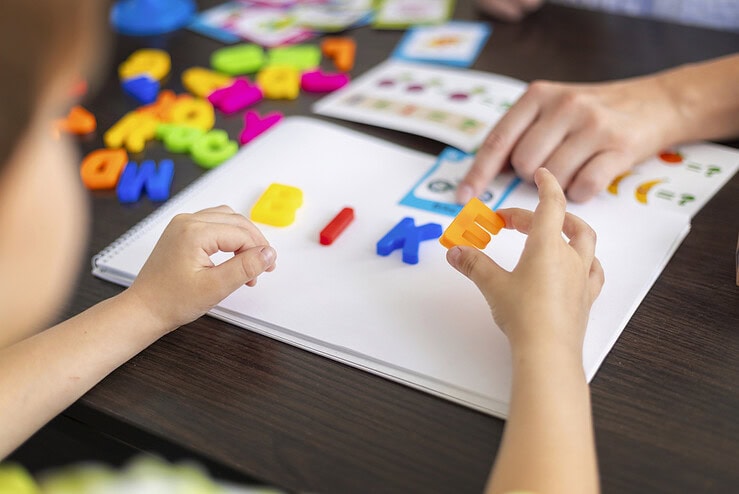
For example, we have devised a learning task for children who are not yet able to read. For approximately 15 minutes, children learn the associations between made-up symbols and speech sounds. They also learn how to combine those symbols into syllables and words, and how to decode series of written symbols to extract meaning. This is similar to the process of learning real letter sounds and using this knowledge to recognize and decode actual words.
The difficulty of the task is adapted to the learning pace of each child. The task gives us measures that can help us predict children’s long-term reading development. Importantly, we consider not only what and how much the children learn while performing the task, but also the variability of children’s individual learning curves. We combine such learning tasks with brain signal recordings, like electroencephalography (EEG), and neuroimaging techniques, like magnetic resonance imaging (MRI). This gives us unique insights into how brain networks change during learning.
Which children need early reading support?
We hope that our research will lead to new screening tools to identify children who may need extra support. Although children in Zurich, where we are based, have excellent access to education, there are disparities in their level of literacy. In Switzerland, 25% of adolescents and 22% of adults have poor reading skills. We urgently need to prevent poor reading outcomes with the help of screenings and interventions designed to support children as early as possible. However, screening for early signs of reading difficulties is becoming more challenging, because an increasing number of children in our region are growing up multilingual and exposed to diverse language environments during their early development.
Most literacy screenings used around the world are developed for monolingual children. For alphabetic languages, these screenings typically include a set of language assessments with tasks such as rhyming, identifying speech sounds in words, and naming a series of objects, as well as exhibiting knowledge of letters and vocabulary. Such screening tools work well for children who speak the majority language – German, in the Zurich region – as their main language, but are not always suitable to be used with children who speak the majority language as a second language or are exposed predominantly to minority languages.
“Multilingualism is multidimensional and contains many layers of complexity.”
On average, second language learners perform worse on screenings than their peers, which makes it difficult to identify the children who require early support and would benefit from it the most. This is why our task uses made-up symbols and speech sounds, rather than German words. We capture learning progression by engaging the cognitive processes involved in learning to read.
In addition, our learning task measures how fast children acquire new knowledge. Most screenings tell us only about children’s current performance and not about their learning potential. Our approach might, in the future, also help to determine where in the learning process difficulties occur and which phase of learning needs support, to inform interventions tailored to individual needs.
Making screenings equitable for multilingual children
Multilingualism is multidimensional and contains many layers of complexity. The multilingual children in our region acquire different combinations of languages and dialects with various sound systems at different ages. They experience uneven exposure to the majority language in contexts like home or school, and they are more likely to grow up in families that are either significantly above or below average in terms of socioeconomic status.
We want to understand how cognitive, linguistic, and environmental factors interact so that we can better distinguish between multilingual variation and early signs of reading difficulties. This would allow for more equitable screenings and early support for children who are at risk of reading difficulties, irrespective of their language experiences.
In Switzerland, 68% of residents use more than one language in their everyday lives, and the percentage is even higher for young people. With multilingualism growing, there is still much to learn about how language diversity affects how children learn to read. In our research, we seek to capture the individual learning trajectories of children with diverse language experiences over time, from the prereading stage through the first years of literacy instruction. This will help us understand to what extent early individual differences in short-term learning are related to long-term growth patterns in reading. This will give us new clues about the complex and dynamic processes that influence every child’s individual path in learning to read.
Authors
Partner
Learning Variability Network Exchange
The Learning Variability Network Exchange (LEVANTE) seeks to understand how children grow, learn, and develop across different times, places, and contexts so that they can be supported to thrive in the multitude of experiences they will encounter throughout life. It brings together researchers from around the world to create the first cross-cultural, multidisciplinary open dataset aiming to capture the richness and diversity of child development and learning. By including data collection of common measures on these different areas longitudinally and at a global level, LEVANTE will help researchers, educators, and policy-makers understand learning and developmental variability, thus improving future outcomes for diverse groups of children worldwide.
Footnotes
This article is part of a series in partnership with LEVANTE, the Learning Variability Network Exchange. LEVANTE is a global research network that is improving our understanding of variability through large scale coordinated data collection. Each article features the latest scientific thinking from one of the research sites of LEVANTE. LEVANTE is an initiative of the Jacobs Foundation.
Using the LEVANTE framework we plan to collect longitudinal data to investigate individual differences in learning development in two ongoing MRI studies in Zurich: The Neural Genetics Trajectories project within the NCCR Evolving Language funded by the Swiss National Science Foundation, and the Child Brain Circuits project of the University Research Priority Program “Adaptive Brain Circuits in Development and Learning (AdaBD)” funded by the University of Zurich.