Teachers’ Voices Season 3 Episode 1
Author

Join educational researcher Nina Alonso for this podcast seriesas she shares powerful stories from teachers around the world, talking in their own words about their own experiences.
How can teachers integrate climate change education into everyday learning? What projects are teachers around the world implementing to help children care for their environments as part of a community? What are the benefits of playing in nature?
“Education must be protected from all the threats around it.”
Stefania Giannini, UNESCO Assistant Director-General for Education
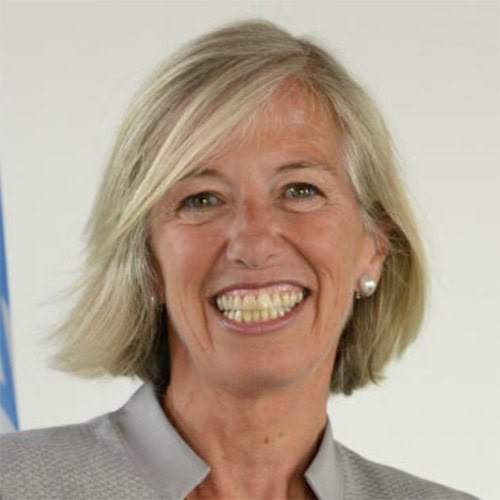
Welcome to the first episode in the third season of Teachers’ Voices. In this episode, Nina talks to Stefania Giannini, the UNESCO Assistant Director-General for Education, in Paris. Stefania tells Nina that “education must be protected from all the threats around it, including climate change.” Education is also part of the solution, she says. Hear Stefania describe the four pillars of UNESCO’s Greening Education Partnership.
Nina also meets Jimmy Brian Kayangue, a former teacher now implementing teacher training in rural Malawi. Jimmy tells Nina about a tree planting project to bring back what has been lost to floods and cyclones. Teachers plant trees with the communities they teach in, Jimmy explains, and “they understand that they are agents of change in their communities”.

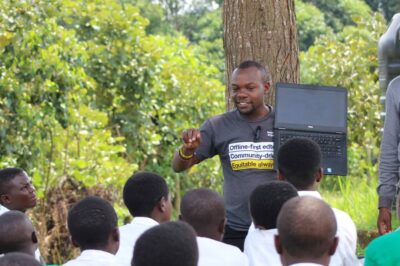
Next, Nina meets Francis Bizoza who works with teachers and students in refugee camps in North Uganda. Francis has been putting together a project-based learning curriculum for out of school refugee children, so they can preserve the environment. Francis also tells Nina about the importance of teaching about global citizenship. “It helps us to bring in a sense of responsibility irrespective of where you are – whether you’re in your home country, whether you’re in a different community.”
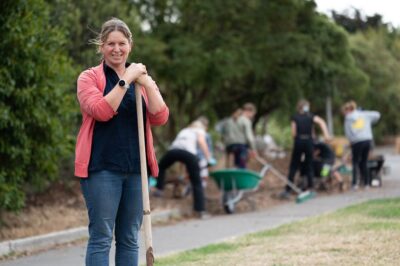
Lastly, Nina hears from Celia Hogan, an educator, author, and founder of Little Kiwis Nature Play in New Zealand. “The children, when we go foraging, they’re learning identification, they’re learning taste, they’re understanding the leaves of the different plants. It’s a connection to nature.” Celia tells Nina that the children often want to share what they have learnt with their parents, sometimes bringing them back at the weekend to show what they’ve been doing.
Listen out for
- Teachers as agents of societal change.
- Play and project-based learning.
- Learning from indigenous knowledge.
Find out more on BOLD
Learning to thrive – Our hub dedicated to supporting children to thrive in a challenging and changing climate.
How climate education can empower students – In season 2 episode 2 of Teachers’ Voices Nina asks what components of learning best support ‘green life skills education’.
How nature can play a role in children’s wellbeing – In season 2 episode 12 of Teachers’ Voices, Nina asks what role nature has in children’s learning and development.
How can schools help children manage climate anxiety? – Science writer Eva Amsen asks what schools and teachers can do to support children experiencing climate anxiety.
Guests and resources
Stefania Giannini, Assistant Director-General for Education at UNESCO
LinkedIn
Facebook
Twitter
UNESCO’s Greening Education Partnership
On the road to COP 28: webinar series
Jimmy Brian Kayangue
LinkedIn
Facebook
DAPP Supports Primary Schools to Plant More Trees
Francis Bizoza
LinkedIn
Facebook
Twitter
YouTube: The African Travelling Teacher
Celia Hogan
LinkedIn
Facebook
Little Kiwis Nature Play
Stefania: Teachers, of course, are the main game changers in the classroom. And they have a major role to play in making climate change education really, actually integrated into everyday learning. This should include reaching out to the community, parents, community leaders, according to different models of society.
Nina: Hello, welcome to the third series of Teachers’ Voices, a podcast made from the stories of teachers from around the world, talking in their own words. I’m your host Nina Alonso and I’ve been traveling and recording new interviews with teachers and experts from the most varied places you can imagine. I will continue to record new interviews as I travel in Europe and Africa, and I will tell you all about it.
But for now, Indy is tilting her head to the right, which in her dog body language means come on.
I’m excited to begin this new series following up an idea we explored in the last series talking about a holistic approach to young people’s sense of self, exploring how it connects with nature and wider society to create a community of learning.
I’m thrilled to take you again on a journey around the globe with teachers and experts in education, accompanied by a distinguished guest, Stefania Giannini. Stefania is the UNESCO Assistant Director General for Education, who is the top UN official in the field. My conversation with Stefania will be followed by inspiring stories from three amazing practitioners, teachers, and teacher’s trainers, who will share how their teaching practices are fostering collaboration between students, schools, and communities for environmental care in different contexts, including particularly vulnerable places.
Let’s first listen to Stefania, who picks up my call from the UNESCO Headquarters in Paris. UNESCO is the main international governmental organization advocating at a global level for education and culture for all. And as I connect, I see Stefania, ready on the mic.
Stefania: Great to see you.
Nina: As she runs from summit to summit and from commitment to another, her team makes sure that technical and practical issues run smoothly.
Stefania: I would say education, it’s both victim of the climate change impact on the planet, as well as very much part of the solution. It’s a victim because we see in so many different regions and context of the world that education has been dramatically disrupted because of these extreme events in Pakistan recently, last year, because of the floods so impressively hitting the country, we had some 30,000 schools destroyed or damaged, consequently, children out of school.
So, education must be protected from all the threats around it, including climate change. But on the other side, for the reason I just mentioned, is very much part of the solution.
Nina: You have probably heard of the Sustainable Development Goals that UNESCO champions. When seeing education as a solution for environmental care, UNESCO emphasizes a holistic approach to education.
Stefania: I cannot imagine, honestly, to have policies, political measures which seriously, effectively address climate change without having education at the core. And that’s why UNESCO and all the partners in the UN started many years ago to talk and to act in a different way through the framework we call Education for Sustainable Development.
That means having a holistic approach to the question of environment and more recently launching a very specific important partnership we call Greening Education Partnership. And through four pillars, very, very simple ones, greening schools, because schools are the places where children actually learn.
They learn knowledge, of course, but they also learn to live together and to interact with the environment in a different way. Greening content, because we have to address the scientific side of the issue. Of course, according to different levels of education, greening teachers’ capacity. You know, we surveyed recently some 70,000 teachers from all over the world.
Ninety percent told us, okay, climate change is essential as a topic to teach in the classroom. Only 20 percent told us we feel to be well equipped. And finally, greening communities, because communities are, you know, where the, the impact of education primarily has its own domain.
Nina: So, as you probably know by now, I’m particularly passionate by teachers, and this podcast seeks to elevate their voice and the status of the teaching profession.
We must listen to teachers more. Because they are the ones who are really working in the front lines who have to bear the deficiencies of the educational systems, all the bureaucracy, but still have to work with children and teach them. So, I was particularly happy to listen to Stefania and how she highlights the role of teachers as an agent for societal change.
Stefania: I think teachers, of course, we do agree are the main game changers in the classroom, and they have a major role to play in making sure climate change education is really actually integrated into everyday learning. This should include the reaching out to the community, parents, community leaders, according to different models of society.
We have good examples of programs happening. I’m thinking of Malawi where we have what they call a tree planting program for future teachers. They train teachers to bring this approach in the classroom and planting trees. It’s a simple gesture, it’s a simple behavior, and I think it can really shape the philosophy, the mindset of children.
Nina: I want to listen to teachers who work in areas that are particularly exposed to climate threats, and I start by following the examples that Stefania had shared with me.
Stefania: In the Global South, the perception of the impact of climate change is quite different. I think that the very first starting point is not to pretend to teach teachers how to teach.
Somehow imposing in a top-down model to the Global South some kind of one size fits for all approach. This is not what UNESCO actually does, as you know. UNESCO is about valorizing and co-creating. The message for teachers is number one, to valorize as much as possible their own knowledge, their own experience, their own way to bring education for sustainable development.
If you are in an African sub-Saharan country, for instance. Could be easier to involve children in their experiential relationship with nature. It’s easier maybe to bring children to be aware of how they have to protect themselves and their community from extreme events, because in some regions at least extreme events are more frequent.
Nina: Inspired by this conversation and those in previous episodes about learning as close to nature as possible, I want to listen to educators who could tell me about experiences from the front lines of teaching and learning, who could illustrate how the interconnection of the four pillars proposed by the Greening Education Agenda can be actionable in concrete terms.
I found an interesting article. That article gave me the name of the leader I was looking for, Jimmy Brian Kayange.
Jimmy: My name is Jimmy Brian Kayange, and I work with DAPP Malawi.
Nina: He was a teacher before, and now works with current and future primary school teachers. In DAPP Malawi, an organization with four teacher training colleges in Malawi, implementing a teacher training model designed to create a new generation of teachers who will bring modern education into poor communities in Malawi.
Jimmy: We have some good initiatives that are coming from our teacher training colleges, which do not just end in the teacher training college, but when these teachers have graduated, then they are applying it in their real time job. When they’re working in the rural areas, we are specifically sending teachers in rural areas where there’s short supply of teachers.
So, we give them skills that they can really extend the communities and be part of evolving those communities.
Nina: I’m curious about the planting tree project that Stefania Giannini had told me about, so I asked Jimmy to describe that project.
Jimmy: Since 2015 in Malawi, we have had problems with frogs and cyclones, so we thought of engaging the teachers in acting in terms of sensitizing and also working together with the communities in bringing back the lost environment. Because we could see that because of a lot of cutting of trees and the like, then it was very easy that most of the communities in Malawi, especially in the southern part of Malawi, were affected by cyclones and the flooding.
Many people lost their lives and their houses, so we thought the best way is to involve the communities to take part in protecting themselves by creating back the environment that was lost. Since 2019, we are planting trees every year, and we are having many trainings with communities on how to protect the environment.
In schools where they were affected by fraud is also part of the teacher training that we are providing to these teachers. Even when they are students, they are also having community projects within the college and around the communities around the colleges where they are already doing this. So, when they go out, it’s just a continuous thing that they are doing, and we started doing this way back. So, it has created that kind of a bond where every week or every two weeks then the parents and the children have some activities in their school where they’re learning a lot from their school and then they are practicing that in their communities. And it has really brought some good collaborations between teachers, between schools and the communities.
Nina: Jimmy talks about the role of the primary school teachers he works with in building communities for environmental care.
Jimmy: The teachers were the ones who were in the forefront. DAPP distributed trees, but the teachers were planting with the communities wherever they are teaching. These are young teachers who have graduated from our colleges. What is very interesting is that now they understand that there are agents of change in their communities.
They’re not just there to teach children in a classroom, but they need to take an active part of being part of developing the communities and changing the mindset of communities in terms of being part of fighting off effects of global warming and climate change.
Nina: I asked Jimmy what the teachers say about children getting involved in these activities for environmental protection and recovery in the community.
Jimmy: They are getting very interesting feedback from the children because of course it’s part of some of the things that the children learn in school in their curriculum but teachers are taking extra initiatives of making sure that the children understand why they should plant the trees and when they start like planting the trees at a school then next thing that the teachers see is the children on their own now they are planting trees with their parents in their communities with the same understanding that they are protecting their houses from wind, heavy winds, and heavy rains.
It is a clear indication that the children have understood why it is important to bring back the lost environment and at the same time they are taking part in also taking care of their own communities.
Nina: Access to electricity is one of the main challenges for families and schools in some remote areas of the Global South.
Like the rural communities in Malawi, where Jimmy works. Their communities need to cut trees to use wood for cooking stoves. Jimmy tells me how teachers are also helping the communities to become less dependent on wood cutting.
Jimmy: Because the teachers that we are working with, they are teachers who are working in rural areas.
As such, we had to say, okay, we understand the problem, but then we are not learning out of solutions. What do we think should we do as a collective? Then we also said, okay, let’s train each other on how to make firewood saving stoves. These are stoves which are made from local available resources, soil and the like.
Yes, they were desperate to say we don’t have electricity, but still we had to provide another solution of making sure that they still keep on cooking using firewood, but not in large quantities.
Nina: Next, we are traveling north in Africa to visit North Uganda, where Francis is waiting for us, but before we leave Jimmy, let’s hear his reflection on his experiences so far with teachers and communities in Malawi.
Jimmy: It was really nice. One, it’s because even from the community members, they’ve got it with a positive mindset, especially also the part of making the fire saving stoves, most of them. Now it is evident that they have fire saving stoves and they keep on planting trees year in, year out. At the same time, it has really developed some passionate people being mindful of why should they avoid to cut trees?
Nina: We now arrive in North Uganda where Francis works with teachers and students in refugee camps. Refugee camps are places of transition, but transitions unfortunately sometimes take a long time and access to resources in these places is always a challenge. Taking care of water resources and improving green resources is key for survival.
Francis: Two weeks ago, I visited my home area. This is a place where we used to have a lot of green cover, like everything was green. We had water sources flowing in the mountains and everything, but right now when you go back the whole place is very dry. You can’t get a drop of water just because of human activities like cutting down trees, like planting trees that make the soil dry, like eucalyptus trees.
Teaching children about the different types of trees to plant. There are trees that coexist with other plants and groups and stuff. So, these are some things that can be done in the classroom for empowering teachers to this level. And once the teachers are empowered, then there is a lot that can be done.
I’ve been putting together a curriculum for out of school refugee children and of age eight plus in northern Uganda. And in this curriculum that I’ve put together is a project-based learning curriculum where learners have been able to have hands on practice about different things, having learners in refugee contexts participate in preserving the environment and conservation, ensuring that we have a green biodiversity. The only gateway to this is doing more of play and project-based learning.
This approach will help the learners to engage in activities that will help them to participate in tree planting, in watering, and stuff.
Nina: Francis tells me about his inspiration for involving teachers and students in activities that help to recover lost nature.
Francis: For example, learning about plants, learning about how plants grow, learn basically as a teacher you open them to what environments favor plant growth, how important planting trees would be for example to ensure that there is a lot of biodiversity happening and we’ll have some trees which produce Oxygen, turns into rain and stuff.
Some of the projects that I put into this curriculum were so exciting for the learners, like developing school gardens. And I think this is the beginning. The learners are doing a project to develop a school garden, and then maybe in their nursery bed they have fruit trees. They have everything, which fruit trees they can take back home to plant.
Nina: Francis says that helping children become aware of their own capacity and develop agency for building communities for environmental care is at the heart of his approach to global citizenship education.
Francis: It helps us to bring in a sense of responsibility, irrespective of where you are, whether you’re in your home country, whether you’re in a different community, you have to develop the urge of being responsible to your environment and knowing that today you’re living here, you might leave and the next day another person will leave. So, you should leave the place in a better place, in a better way. So, we need to look at how to integrate global citizenship education, integrate it with things like empathy.
Nina: We leave Africa and move to a very different context, to New Zealand. A place that, for some of us, represents the dream of a rich and well-preserved green environment. As a researcher, I’m aware of the importance of early childhood education for children’s learning and development. So, I wanted to hear from an experienced educator working closely with young children, but also with parents and teachers.
Celia Hogan is an author, the founder of Little Kiwis, and a facilitator, but above all, an educator passionate about free play in nature. At one time, we were going to connect, the area where Celia lives and works was hit by a typhoon. This reminded me that even if New Zealand is a rich green country, it is also exposed to the consequences of increasingly unpredictable changes in climate.
So, we finally managed to have a conversation while I was in Kenya, participating in a convening about foundational learning. Celia describes her context and the kind of activity that children at Little Kiwis typically learn from.
Celia: We’re really lucky. We have apple trees, pear trees, plum trees. We have nuts, we have chestnuts, pine nuts, all these things, berries.
It’s awesome seeing the children learning to identify the different fruits and produce that we can find on our site. And so, the children, when we go foraging, they’re learning identification, they’re learning taste, they’re understanding the leaves of the different plants. It’s a connection to nature.
It’s also kind of going, oh, how did this grow? And, oh, here’s a little seedling. So, we’re kind of really understanding where food comes from. And sometimes what we’ll do is we’ll invite children to come foraging with us and then we will make a tea out of what we forage. So, we might have found some wild mint, some lemons and some berries and apple.
The children will then come back, and we will have a table set up where they can cut up their fruit and then put it in a large kind of glass jar that they can see into. And then what we do is we pour boiling water while the children stand back into that jar, and it changes color. The water goes from clear to this kind of ready or yellowy type colors.
And they can see that straight away just from all the fruit that’s in there, and it’s just a lovely process of going out, collecting the food, bringing it back, preparing it, and then creating something that then they can drink and taste. And then they’ll experiment with it. They’ll go, oh, that one was a bit sour.
Let’s see if we can make it a little bit nicer to drink. And so, they’ll make another one and it will have a different flavor. And so, they’re experimenting and building on their existing knowledge. So, it’s just a really cool thing.
Nina: One of the issues that we will explore in this new series of Teachers Voices is how to learn from indigenous knowledge when developing more holistic approaches to teaching. Let’s hear how Little Kiwis brings on board the indigenous knowledge of the Māori people.
Celia: So here in New Zealand, Aotearoa New Zealand, we weave a lot of indigenous knowledge or Mātauranga Māori into much of what we do in all educational programs.
So, what that looks like is a lot of language, Te Reo Māori. We use it for greetings, you know, mōrena, which means good morning. We use it for naming our plants. So, harakeke is a flax bush or for our birds and our wildlife for our insects. So manu is bird. So, we’re kind of weaving it into all that we do, and also, we have kind of traditions that we adhere to.
So, Māori often start all their meetings or their gatherings with what we call a karakia. And so, a karakia, it’s kind of like a prayer. And so, we start our days with that, and we also have other little traditions of, you know, just connecting at the start of the day. Another tradition I thought would be a good example to share with you is that for Māori, everything is connected to nature, and many of their traditional stories, which are called pūrākau, talk about the environment and the ātua.
So, ātua are like the guardians of different realms. So, Tāne Mahuta, is the ātua or guardian of forest and birds. When our children or tamariki go out and collect any of the natural elements, we encourage them to thank Tāne Mahuta for that gift, for that Taonga. And so, you will often hear children picking up a stick or a stone or a feather, and you’ll hear them say, thanks, Tāne.
So, it’s, it’s beautiful the way our curriculum weaves into kind of Mātauranga Māori or Māori knowledge. Yeah, so we’re doing it through language. We’re doing it through our traditions, ways of doing things. We’re doing it through stories like pūrākau and also just that general knowledge or Mātauranga Māori.
Nina: I asked Celia if the young learners at Little Kiwis share their learnings with their communities.
Celia: We often get feedback from parents saying, oh, the children came home with their little seedling, and they wanted their own little vegetable garden now. So, you know, you get, they take that home with them. It doesn’t just stay where they are or, or they’ll bring their parents back on the weekends.
They come and look what we were doing. And so, it’s, you know, it’s really neat just that, that deep presence that children have when they do these things, and they want to show, and they want to get really absorbed in it. It’s amazing.
Nina: We will hear from Celia again in another episode. Stay tuned. Now a final word from Celia about the Little Kiwis.
Celia: I like how present they are and how they are where their feet are. They’re so grounded. They absorb information like nothing else, but we also, we don’t have to be direct teaching them. They are little sponges, and they will ask questions if they need to, or they will explore and experiment themselves. And they blow me away by how capable, how physically capable they actually are.
And I think in our current society, we get a little bit confused by that. We kind of think that we need to protect them from harm and we’re like, no, don’t do this. But they’re actually really physically capable. But on the other side, we often expect them to be really emotionally developed because they can talk, but it’s actually the opposite.
They need more support with that emotional development, and they need to be trusted more with their physical development.
Nina: Celia, Jimmy and Francis show how supporting children to care for the environment can help them strengthen their relationships with the environment and with their communities. If there is one thing that I have learned through this podcast is that teachers listen to teachers, teachers trust other teachers and our guests today, who have themselves been teachers before and also train now and guide other teachers, are constantly listening and learning from them.
Only by transforming education, we will be able to face the present challenges that the world is living. Because of their unique position in their daily work with children and communities, teachers are a key agent for driving societal change. Project-based learning motivates children in challenging environments to be well informed agents of change in their communities.
Also, learning through direct experience in nature with the soil, plants, and trees of each particular land can help children and communities to be more caring and connected to their social and natural environments. As we have heard also, UNESCO is partnering with local, regional, and international agents to advocate for a greener education.
Now, for a final reflection from Stefania Giannini. She talks about the key role of education in the big challenges that our contemporary global society faces, not just from the environment, but also in terms of digital technology.
Stefania: Education is about empowerment, is about changing or shaping mindset of people, especially young generation, but not exclusively.
And accordingly, it’s about changing behaviors. I do believe that if you want to rethink the relationship between humans and the planet, the environment between humans and technology, especially now that a new generation of technology are impressively coming out, disrupting our way of working and living and learning, we need a different transformative model of education.
So, education is very much at the core of green transition as well as the digital transition.
Nina: If you enjoyed this episode, you can find more about our guests and about UNESCO’s Greening Educational Agenda on BOLD.expert and in the show notes. If you are interested in supporting children to thrive in challenging climate, you can also find a link to a range of materials to help you reflect on the topics, engage with young people, and start conversations.
Following on from Stefania’s reflection on the digital transition, our next two episodes will be about teaching and learning supported by artificial intelligence. I will talk to experts and teachers about the challenges and opportunities arising from the increased use of AI in the classroom. Thank you for listening to Teachers’ Voices produced in partnership with BOLD, the digital platform on children’s learning and development. Let’s keep on building sustainable learning communities while reaching research and practice.
Stefania: Teachers, of course, are the main game changers in the classroom. And they have a major role to play in making climate change education really, actually integrated into everyday learning. This should include reaching out to the community, parents, community leaders, according to different models of society.
Nina: Hello, welcome to the third series of Teachers’ Voices, a podcast made from the stories of teachers from around the world, talking in their own words. I’m your host Nina Alonso and I’ve been traveling and recording new interviews with teachers and experts from the most varied places you can imagine. I will continue to record new interviews as I travel in Europe and Africa, and I will tell you all about it.
But for now, Indy is tilting her head to the right, which in her dog body language means come on.
I’m excited to begin this new series following up an idea we explored in the last series talking about a holistic approach to young people’s sense of self, exploring how it connects with nature and wider society to create a community of learning.
I’m thrilled to take you again on a journey around the globe with teachers and experts in education, accompanied by a distinguished guest, Stefania Giannini. Stefania is the UNESCO Assistant Director General for Education, who is the top UN official in the field. My conversation with Stefania will be followed by inspiring stories from three amazing practitioners, teachers, and teacher’s trainers, who will share how their teaching practices are fostering collaboration between students, schools, and communities for environmental care in different contexts, including particularly vulnerable places.
Let’s first listen to Stefania, who picks up my call from the UNESCO Headquarters in Paris. UNESCO is the main international governmental organization advocating at a global level for education and culture for all. And as I connect, I see Stefania, ready on the mic.
Stefania: Great to see you.
Nina: As she runs from summit to summit and from commitment to another, her team makes sure that technical and practical issues run smoothly.
Stefania: I would say education, it’s both victim of the climate change impact on the planet, as well as very much part of the solution. It’s a victim because we see in so many different regions and context of the world that education has been dramatically disrupted because of these extreme events in Pakistan recently, last year, because of the floods so impressively hitting the country, we had some 30,000 schools destroyed or damaged, consequently, children out of school.
So, education must be protected from all the threats around it, including climate change. But on the other side, for the reason I just mentioned, is very much part of the solution.
Nina: You have probably heard of the Sustainable Development Goals that UNESCO champions. When seeing education as a solution for environmental care, UNESCO emphasizes a holistic approach to education.
Stefania: I cannot imagine, honestly, to have policies, political measures which seriously, effectively address climate change without having education at the core. And that’s why UNESCO and all the partners in the UN started many years ago to talk and to act in a different way through the framework we call Education for Sustainable Development.
That means having a holistic approach to the question of environment and more recently launching a very specific important partnership we call Greening Education Partnership. And through four pillars, very, very simple ones, greening schools, because schools are the places where children actually learn.
They learn knowledge, of course, but they also learn to live together and to interact with the environment in a different way. Greening content, because we have to address the scientific side of the issue. Of course, according to different levels of education, greening teachers’ capacity. You know, we surveyed recently some 70,000 teachers from all over the world.
Ninety percent told us, okay, climate change is essential as a topic to teach in the classroom. Only 20 percent told us we feel to be well equipped. And finally, greening communities, because communities are, you know, where the, the impact of education primarily has its own domain.
Nina: So, as you probably know by now, I’m particularly passionate by teachers, and this podcast seeks to elevate their voice and the status of the teaching profession.
We must listen to teachers more. Because they are the ones who are really working in the front lines who have to bear the deficiencies of the educational systems, all the bureaucracy, but still have to work with children and teach them. So, I was particularly happy to listen to Stefania and how she highlights the role of teachers as an agent for societal change.
Stefania: I think teachers, of course, we do agree are the main game changers in the classroom, and they have a major role to play in making sure climate change education is really actually integrated into everyday learning. This should include the reaching out to the community, parents, community leaders, according to different models of society.
We have good examples of programs happening. I’m thinking of Malawi where we have what they call a tree planting program for future teachers. They train teachers to bring this approach in the classroom and planting trees. It’s a simple gesture, it’s a simple behavior, and I think it can really shape the philosophy, the mindset of children.
Nina: I want to listen to teachers who work in areas that are particularly exposed to climate threats, and I start by following the examples that Stefania had shared with me.
Stefania: In the Global South, the perception of the impact of climate change is quite different. I think that the very first starting point is not to pretend to teach teachers how to teach.
Somehow imposing in a top-down model to the Global South some kind of one size fits for all approach. This is not what UNESCO actually does, as you know. UNESCO is about valorizing and co-creating. The message for teachers is number one, to valorize as much as possible their own knowledge, their own experience, their own way to bring education for sustainable development.
If you are in an African sub-Saharan country, for instance. Could be easier to involve children in their experiential relationship with nature. It’s easier maybe to bring children to be aware of how they have to protect themselves and their community from extreme events, because in some regions at least extreme events are more frequent.
Nina: Inspired by this conversation and those in previous episodes about learning as close to nature as possible, I want to listen to educators who could tell me about experiences from the front lines of teaching and learning, who could illustrate how the interconnection of the four pillars proposed by the Greening Education Agenda can be actionable in concrete terms.
I found an interesting article. That article gave me the name of the leader I was looking for, Jimmy Brian Kayange.
Jimmy: My name is Jimmy Brian Kayange, and I work with DAPP Malawi.
Nina: He was a teacher before, and now works with current and future primary school teachers. In DAPP Malawi, an organization with four teacher training colleges in Malawi, implementing a teacher training model designed to create a new generation of teachers who will bring modern education into poor communities in Malawi.
Jimmy: We have some good initiatives that are coming from our teacher training colleges, which do not just end in the teacher training college, but when these teachers have graduated, then they are applying it in their real time job. When they’re working in the rural areas, we are specifically sending teachers in rural areas where there’s short supply of teachers.
So, we give them skills that they can really extend the communities and be part of evolving those communities.
Nina: I’m curious about the planting tree project that Stefania Giannini had told me about, so I asked Jimmy to describe that project.
Jimmy: Since 2015 in Malawi, we have had problems with frogs and cyclones, so we thought of engaging the teachers in acting in terms of sensitizing and also working together with the communities in bringing back the lost environment. Because we could see that because of a lot of cutting of trees and the like, then it was very easy that most of the communities in Malawi, especially in the southern part of Malawi, were affected by cyclones and the flooding.
Many people lost their lives and their houses, so we thought the best way is to involve the communities to take part in protecting themselves by creating back the environment that was lost. Since 2019, we are planting trees every year, and we are having many trainings with communities on how to protect the environment.
In schools where they were affected by fraud is also part of the teacher training that we are providing to these teachers. Even when they are students, they are also having community projects within the college and around the communities around the colleges where they are already doing this. So, when they go out, it’s just a continuous thing that they are doing, and we started doing this way back. So, it has created that kind of a bond where every week or every two weeks then the parents and the children have some activities in their school where they’re learning a lot from their school and then they are practicing that in their communities. And it has really brought some good collaborations between teachers, between schools and the communities.
Nina: Jimmy talks about the role of the primary school teachers he works with in building communities for environmental care.
Jimmy: The teachers were the ones who were in the forefront. DAPP distributed trees, but the teachers were planting with the communities wherever they are teaching. These are young teachers who have graduated from our colleges. What is very interesting is that now they understand that there are agents of change in their communities.
They’re not just there to teach children in a classroom, but they need to take an active part of being part of developing the communities and changing the mindset of communities in terms of being part of fighting off effects of global warming and climate change.
Nina: I asked Jimmy what the teachers say about children getting involved in these activities for environmental protection and recovery in the community.
Jimmy: They are getting very interesting feedback from the children because of course it’s part of some of the things that the children learn in school in their curriculum but teachers are taking extra initiatives of making sure that the children understand why they should plant the trees and when they start like planting the trees at a school then next thing that the teachers see is the children on their own now they are planting trees with their parents in their communities with the same understanding that they are protecting their houses from wind, heavy winds, and heavy rains.
It is a clear indication that the children have understood why it is important to bring back the lost environment and at the same time they are taking part in also taking care of their own communities.
Nina: Access to electricity is one of the main challenges for families and schools in some remote areas of the Global South.
Like the rural communities in Malawi, where Jimmy works. Their communities need to cut trees to use wood for cooking stoves. Jimmy tells me how teachers are also helping the communities to become less dependent on wood cutting.
Jimmy: Because the teachers that we are working with, they are teachers who are working in rural areas.
As such, we had to say, okay, we understand the problem, but then we are not learning out of solutions. What do we think should we do as a collective? Then we also said, okay, let’s train each other on how to make firewood saving stoves. These are stoves which are made from local available resources, soil and the like.
Yes, they were desperate to say we don’t have electricity, but still we had to provide another solution of making sure that they still keep on cooking using firewood, but not in large quantities.
Nina: Next, we are traveling north in Africa to visit North Uganda, where Francis is waiting for us, but before we leave Jimmy, let’s hear his reflection on his experiences so far with teachers and communities in Malawi.
Jimmy: It was really nice. One, it’s because even from the community members, they’ve got it with a positive mindset, especially also the part of making the fire saving stoves, most of them. Now it is evident that they have fire saving stoves and they keep on planting trees year in, year out. At the same time, it has really developed some passionate people being mindful of why should they avoid to cut trees?
Nina: We now arrive in North Uganda where Francis works with teachers and students in refugee camps. Refugee camps are places of transition, but transitions unfortunately sometimes take a long time and access to resources in these places is always a challenge. Taking care of water resources and improving green resources is key for survival.
Francis: Two weeks ago, I visited my home area. This is a place where we used to have a lot of green cover, like everything was green. We had water sources flowing in the mountains and everything, but right now when you go back the whole place is very dry. You can’t get a drop of water just because of human activities like cutting down trees, like planting trees that make the soil dry, like eucalyptus trees.
Teaching children about the different types of trees to plant. There are trees that coexist with other plants and groups and stuff. So, these are some things that can be done in the classroom for empowering teachers to this level. And once the teachers are empowered, then there is a lot that can be done.
I’ve been putting together a curriculum for out of school refugee children and of age eight plus in northern Uganda. And in this curriculum that I’ve put together is a project-based learning curriculum where learners have been able to have hands on practice about different things, having learners in refugee contexts participate in preserving the environment and conservation, ensuring that we have a green biodiversity. The only gateway to this is doing more of play and project-based learning.
This approach will help the learners to engage in activities that will help them to participate in tree planting, in watering, and stuff.
Nina: Francis tells me about his inspiration for involving teachers and students in activities that help to recover lost nature.
Francis: For example, learning about plants, learning about how plants grow, learn basically as a teacher you open them to what environments favor plant growth, how important planting trees would be for example to ensure that there is a lot of biodiversity happening and we’ll have some trees which produce Oxygen, turns into rain and stuff.
Some of the projects that I put into this curriculum were so exciting for the learners, like developing school gardens. And I think this is the beginning. The learners are doing a project to develop a school garden, and then maybe in their nursery bed they have fruit trees. They have everything, which fruit trees they can take back home to plant.
Nina: Francis says that helping children become aware of their own capacity and develop agency for building communities for environmental care is at the heart of his approach to global citizenship education.
Francis: It helps us to bring in a sense of responsibility, irrespective of where you are, whether you’re in your home country, whether you’re in a different community, you have to develop the urge of being responsible to your environment and knowing that today you’re living here, you might leave and the next day another person will leave. So, you should leave the place in a better place, in a better way. So, we need to look at how to integrate global citizenship education, integrate it with things like empathy.
Nina: We leave Africa and move to a very different context, to New Zealand. A place that, for some of us, represents the dream of a rich and well-preserved green environment. As a researcher, I’m aware of the importance of early childhood education for children’s learning and development. So, I wanted to hear from an experienced educator working closely with young children, but also with parents and teachers.
Celia Hogan is an author, the founder of Little Kiwis, and a facilitator, but above all, an educator passionate about free play in nature. At one time, we were going to connect, the area where Celia lives and works was hit by a typhoon. This reminded me that even if New Zealand is a rich green country, it is also exposed to the consequences of increasingly unpredictable changes in climate.
So, we finally managed to have a conversation while I was in Kenya, participating in a convening about foundational learning. Celia describes her context and the kind of activity that children at Little Kiwis typically learn from.
Celia: We’re really lucky. We have apple trees, pear trees, plum trees. We have nuts, we have chestnuts, pine nuts, all these things, berries.
It’s awesome seeing the children learning to identify the different fruits and produce that we can find on our site. And so, the children, when we go foraging, they’re learning identification, they’re learning taste, they’re understanding the leaves of the different plants. It’s a connection to nature.
It’s also kind of going, oh, how did this grow? And, oh, here’s a little seedling. So, we’re kind of really understanding where food comes from. And sometimes what we’ll do is we’ll invite children to come foraging with us and then we will make a tea out of what we forage. So, we might have found some wild mint, some lemons and some berries and apple.
The children will then come back, and we will have a table set up where they can cut up their fruit and then put it in a large kind of glass jar that they can see into. And then what we do is we pour boiling water while the children stand back into that jar, and it changes color. The water goes from clear to this kind of ready or yellowy type colors.
And they can see that straight away just from all the fruit that’s in there, and it’s just a lovely process of going out, collecting the food, bringing it back, preparing it, and then creating something that then they can drink and taste. And then they’ll experiment with it. They’ll go, oh, that one was a bit sour.
Let’s see if we can make it a little bit nicer to drink. And so, they’ll make another one and it will have a different flavor. And so, they’re experimenting and building on their existing knowledge. So, it’s just a really cool thing.
Nina: One of the issues that we will explore in this new series of Teachers Voices is how to learn from indigenous knowledge when developing more holistic approaches to teaching. Let’s hear how Little Kiwis brings on board the indigenous knowledge of the Māori people.
Celia: So here in New Zealand, Aotearoa New Zealand, we weave a lot of indigenous knowledge or Mātauranga Māori into much of what we do in all educational programs.
So, what that looks like is a lot of language, Te Reo Māori. We use it for greetings, you know, mōrena, which means good morning. We use it for naming our plants. So, harakeke is a flax bush or for our birds and our wildlife for our insects. So manu is bird. So, we’re kind of weaving it into all that we do, and also, we have kind of traditions that we adhere to.
So, Māori often start all their meetings or their gatherings with what we call a karakia. And so, a karakia, it’s kind of like a prayer. And so, we start our days with that, and we also have other little traditions of, you know, just connecting at the start of the day. Another tradition I thought would be a good example to share with you is that for Māori, everything is connected to nature, and many of their traditional stories, which are called pūrākau, talk about the environment and the ātua.
So, ātua are like the guardians of different realms. So, Tāne Mahuta, is the ātua or guardian of forest and birds. When our children or tamariki go out and collect any of the natural elements, we encourage them to thank Tāne Mahuta for that gift, for that Taonga. And so, you will often hear children picking up a stick or a stone or a feather, and you’ll hear them say, thanks, Tāne.
So, it’s, it’s beautiful the way our curriculum weaves into kind of Mātauranga Māori or Māori knowledge. Yeah, so we’re doing it through language. We’re doing it through our traditions, ways of doing things. We’re doing it through stories like pūrākau and also just that general knowledge or Mātauranga Māori.
Nina: I asked Celia if the young learners at Little Kiwis share their learnings with their communities.
Celia: We often get feedback from parents saying, oh, the children came home with their little seedling, and they wanted their own little vegetable garden now. So, you know, you get, they take that home with them. It doesn’t just stay where they are or, or they’ll bring their parents back on the weekends.
They come and look what we were doing. And so, it’s, you know, it’s really neat just that, that deep presence that children have when they do these things, and they want to show, and they want to get really absorbed in it. It’s amazing.
Nina: We will hear from Celia again in another episode. Stay tuned. Now a final word from Celia about the Little Kiwis.
Celia: I like how present they are and how they are where their feet are. They’re so grounded. They absorb information like nothing else, but we also, we don’t have to be direct teaching them. They are little sponges, and they will ask questions if they need to, or they will explore and experiment themselves. And they blow me away by how capable, how physically capable they actually are.
And I think in our current society, we get a little bit confused by that. We kind of think that we need to protect them from harm and we’re like, no, don’t do this. But they’re actually really physically capable. But on the other side, we often expect them to be really emotionally developed because they can talk, but it’s actually the opposite.
They need more support with that emotional development, and they need to be trusted more with their physical development.
Nina: Celia, Jimmy and Francis show how supporting children to care for the environment can help them strengthen their relationships with the environment and with their communities. If there is one thing that I have learned through this podcast is that teachers listen to teachers, teachers trust other teachers and our guests today, who have themselves been teachers before and also train now and guide other teachers, are constantly listening and learning from them.
Only by transforming education, we will be able to face the present challenges that the world is living. Because of their unique position in their daily work with children and communities, teachers are a key agent for driving societal change. Project-based learning motivates children in challenging environments to be well informed agents of change in their communities.
Also, learning through direct experience in nature with the soil, plants, and trees of each particular land can help children and communities to be more caring and connected to their social and natural environments. As we have heard also, UNESCO is partnering with local, regional, and international agents to advocate for a greener education.
Now, for a final reflection from Stefania Giannini. She talks about the key role of education in the big challenges that our contemporary global society faces, not just from the environment, but also in terms of digital technology.
Stefania: Education is about empowerment, is about changing or shaping mindset of people, especially young generation, but not exclusively.
And accordingly, it’s about changing behaviors. I do believe that if you want to rethink the relationship between humans and the planet, the environment between humans and technology, especially now that a new generation of technology are impressively coming out, disrupting our way of working and living and learning, we need a different transformative model of education.
So, education is very much at the core of green transition as well as the digital transition.
Nina: If you enjoyed this episode, you can find more about our guests and about UNESCO’s Greening Educational Agenda on BOLD.expert and in the show notes. If you are interested in supporting children to thrive in challenging climate, you can also find a link to a range of materials to help you reflect on the topics, engage with young people, and start conversations.
Following on from Stefania’s reflection on the digital transition, our next two episodes will be about teaching and learning supported by artificial intelligence. I will talk to experts and teachers about the challenges and opportunities arising from the increased use of AI in the classroom. Thank you for listening to Teachers’ Voices produced in partnership with BOLD, the digital platform on children’s learning and development. Let’s keep on building sustainable learning communities while reaching research and practice.
Author
Guests' stories

Guests' stories