Learning to thrive
What is the role of play, agency, compassion and nature in children’s wellbeing and development?
Authors


There is growing evidence that young people are concerned about the state of the natural world around them. They are exposed to stories about the changing climate, biodiversity loss, habitat destruction and about the impacts this has both now, and on their futures. The feelings of anxiety and uncertainty this can cause, in turn may affect the wellbeing of young people and their wider learning and development.
There is also growing evidence that providing young people with opportunities to connect with nature could make a difference. Spending time in nature can reduce our stress and help us regulate our emotions. Could it also improve general wellbeing? Paying greater attention to the world around us has been linked to higher levels of concern for the environment and for those with which we share it. Could this increase the likelihood of finding positive responses to some of the challenges posed by living in a climate of uncertainty?
The animation was created to help start conversations about the different ways in which we can help young people to thrive in a challenging world.
If you’re interested in supporting children to thrive in a challenging and changing climate, there is a range of materials to help reflect on the topics, engage with young people and start the conversations.
Our world can be an amazing place, full of wonder and surprise.
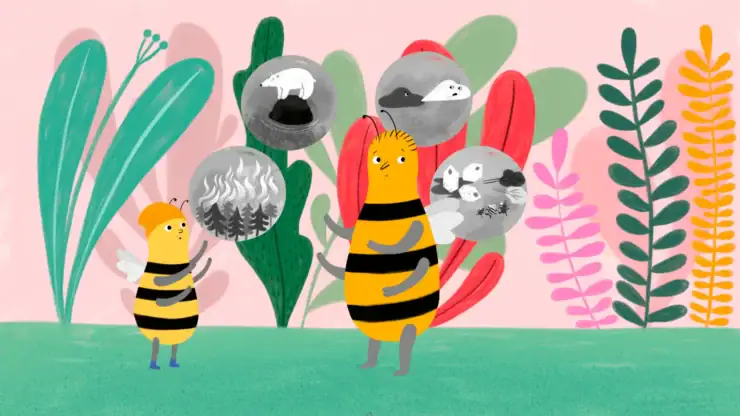
But it is also a world facing challenges that can leave us feeling concerned, confused or frustrated.
When we think about our future, these challenges and the uncertainties they create can cause anxiety. In children, as well as adults.
This anxiety can lead to a sense of helplessness, making it harder to act or think about things in a more positive way.
Sharing our thoughts and concerns with those close to us isn’t always easy. For children, this may feel particularly difficult — which challenges us as adults too.
We might be afraid of saying the wrong thing. Or perhaps not knowing enough. But could saying or doing nothing make things worse?
What if we could better connect with one another? With the world around us? With the concerns that we have for our futures?
Although our anxieties and concerns can leave us feeling overwhelmed and uncertain, with a little support we just might discover that there are ideas all around us.
The more opportunities we take to connect with nature and notice its effects…
The more we can help each other to thrive.
When we actively connect children with nature, we are giving them — and us — the chance to discover and experience the wonder that exists in our natural world.
We can nurture a greater awareness of the natural systems that surround us, and a better understanding of the ways all of us are connected to nature.
By pausing and noticing things that may previously have been hidden in plain sight…
…we can begin to explore new perspectives and new worlds. And as our curiosity about nature grows, so too does our connection with it.
Creating and rediscovering these connections not only benefits our natural world, it could improve our well-being too.
The simple act of being in or around nature can reduce our stress and anxiety — helping us to relax, inviting us to feel more open-minded.
Children, and adults who spend time in nature are more likely to be caring towards natural environments and towards each other.
Bathing in natural spaces can improve our mental health, nurture our relationships, and build our resilience and agency to embrace uncertainty.
Connecting with nature can motivate us to be the difference we want to see in the world.
It can be tempting to believe that, if we want to be successful, we must each focus on our own way in the world.
But the more we connect with people, the more we encounter ideas and actions that inspire us.
We are more likely to experience the joys and benefits of caring, thinking and learning with those around us.
After all, we are social beings who thrive through connection, communication, and co-operation.
Learning alongside others means we can benefit from the varied experiences and ideas of those around us.
Sharing perspectives with each other, and our children, can expand our understanding and ideas. It may even lead us towards new or different ways of behaving.
Becoming more curious and engaged in the communities that we are part of, can help us all to discover new skills and build on our existing strengths.
Listening, sharing and playing together can help us to feel part of something bigger than ourselves; to find new and better ways to care for one another, for ourselves, and for our local environments.
Play is an essential part of growing up. A playful outlook can be beneficial for children and adults. What if we let go more often? What if we gave ourselves permission to be more playful?
Play can help us to thrive — to experience, sense, and imagine the world in new ways. Play helps us see things from a different point of view.
Through play, we can see new possibilities and dream of alternative futures. There are no limits to what we might imagine!
Balancing playfulness and hope with the reality of the challenges we face can be difficult at times. This is true for children too. We might ask: How can we support them, and ourselves, to find a healthy balance in uncertain times?
By exchanging ideas with each other, we could find the confidence to identify, and even create, solutions to some of our shared challenges.
Embracing and capturing opportunities to make connections with nature and each other, no matter how small, might be a good starting point…
These connections remind us that we are part of something bigger. That we can be there for one another. That we can help each other to thrive.
No opportunity is too limited or too small. When we help children to make connections, we empower them. This can improve their wellbeing, equipping them with the capabilities needed to thrive in an uncertain future.
Though our world can be complicated and challenging, it is full of wonder, beauty, and potential.
Children can thrive in this world. We can help by giving them opportunities to connect with nature and with others. Listening to children’s voices and understanding their experiences can help us imagine and build better futures together.
Authors
Footnotes
Produced by PositiveNegatives for BOLD
In collaboration with Lifeworlds
Powered by the Jacobs Foundation
Direction
Dr Benjamin Worku-Dix
Scriptwriter
John Servante
Illustration
Gabi Froden
Animation
Diana García