Recognizing students who are less vocal
What robotics education can teach us about appreciating different forms of youth knowledge
Author

Chunyan Yang co-wrote this article with Anita Wei, a high school lead student facilitator from the Co-Learn Code and Mind program, described below.
Robotics learning should begin with young people – their questions, their daily experiences, and their hopes for their communities. In our after-school robotics initiative Co-Learn Code and Mind, we bring together youth voice, hands-on robotics, and transformative social and emotional learning. Our experience made us wonder: how do adults recognize when young people are contributing?
Not all contributions are verbal
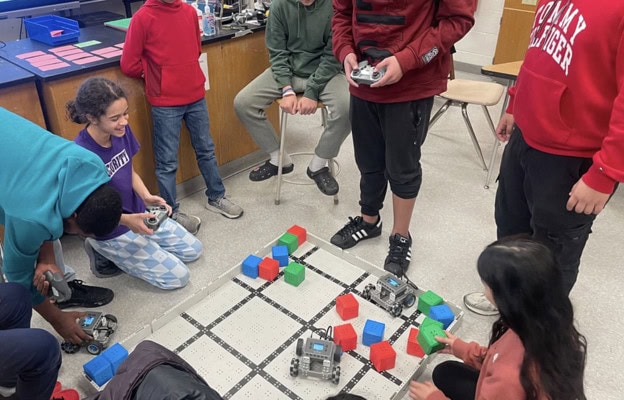
Typically, student participation is thought of as verbal. Young people are invited to speak, reflect, explain, or present their ideas, and adults hear and respond to their voices. Yet in our robotics sessions, participation is not always verbal. A student might adjust a robot’s sensor placement after noticing repeated failure during testing. Another might abandon a design pathway that looked promising on paper but keeps breaking in practice. A team member might say little during group discussions but become the person others turn to when the build is unstable or the code stops working. These students reshape the direction of the project and influence what the group tries next, even if they don’t provide verbal explanations.
Students may engage meaningfully, shaping collective work in ways that are not expressed through speech. Their participation takes the form of building, testing, revising, noticing, adjusting, persisting, and redirecting the work. They often demonstrate what they know before they are able to explain it. They might recognize that a structure is unstable, a sequence is inefficient, or a design choice does not fit the problem they are trying to solve. They may not, and perhaps cannot, verbalize why, but their judgments shape what happens next.
It’s not just in robotics: Learning often develops through participation in shared practices, by making, experimenting, and acting in the world, rather than through explanation alone. Yet many educational spaces still rely on articulation. Speech, reflection, and explanation are the most recognizable signs that students are contributing, but contributions that take place through action should not be overlooked.
“Speech, reflection, and explanation are the most recognizable signs that students are contributing, but contributions that take place through action should not be overlooked.”
A hidden hierarchy in the concept of youth voice
Youth voice has become important in education and community engagement. It challenges adult-centered assumptions about who defines problems and imagines solutions. But voice is often treated as synonymous with speech. The students who are most easily recognized as contributors are often those who are comfortable speaking in institutional settings, or who are able to reflect quickly on their experiences. These are important forms of participation, but they are not the only ones.
Many young people engage first through observation, experimentation, and hands-on activity. Some have had limited opportunities to share personal reflections in school spaces. Others may feel uncertain about speaking publicly. Some simply think by building and trying things out. In our robotics program, we create multiple pathways for expression. Students might begin by drawing their ideas, taking photographs around their school, or building early prototypes before speaking about their thinking. Over time, many students find their voices through these experiences. We have come to appreciate that not every meaningful contribution culminates in articulation. Sometimes insight is expressed through action.
Robotics education makes this especially visible because it translates ideas into motion. When students sketch designs, connect wires, code motors, and test structures, ideas take on concrete form. Some designs fail quickly; others work in unexpected ways. Students respond by adjusting their designs, revising their code, or rethinking their approach. These decisions shape the direction of the project and influence what the group learns together. Students judge what works, what doesn’t, and what should happen next. Their actions shape collective learning and problem-solving, even when decisions are not accompanied by detailed explanations.
Inclusion is not the same as recognition
A learning space may be inclusive in the sense that young people are invited in and encouraged to participate. But contributions through action may fail to be recognized as knowledge when recognition depends mainly on articulation, even when such contributions are central to the work.
“But contributions through action may fail to be recognized as knowledge when recognition depends mainly on articulation, even when such contributions are central to the work.”
If we are serious about centering youth knowledge, we must examine not only who is invited to participate, but how we recognize participation. We need to recognize knowledge that takes the form of action, even if it is not spoken – in all types of education, not just robotics.
How teachers can recognize active participation
● Notice and name the many ways students contribute to shared learning: when they observe carefully, build or test ideas, revise their work, document the group’s process, help peers, or solve problems.
● Create multiple pathways for students to express their thinking, including through sketches, prototypes, demonstrations, design journals, photographs, small-group conversations, and quiet reflection before whole-class sharing.
● Shed light on power dynamics among students by asking whose ideas are taken up, who has access to materials, who is positioned as an expert, and whose contributions may be overlooked.
Author