How children develop a sense of fairness
Understanding equality is a crucial part of a child's social world
Author

Almost any group of children at snack time is attuned to what everyone else has, wanting to make it as fair as possible. My children regularly compare their pieces of cake or glasses of milk, and lament when they aren’t given exactly the same.
As children compare themselves with others on a daily basis, learning how to react appropriately to inequity is an important skill for them to master – and it is learnt from an early age.
How and why children develop a sense of fairness is what Katherine McAuliffe, a developmental psychologist at Boston College, has spent her career asking. She says a sense of fairness helps children understand the moral and social rules that are part of many human interactions.
“As children compare themselves with others on a daily basis, learning how to react appropriately to inequity is an important skill for them to master.”
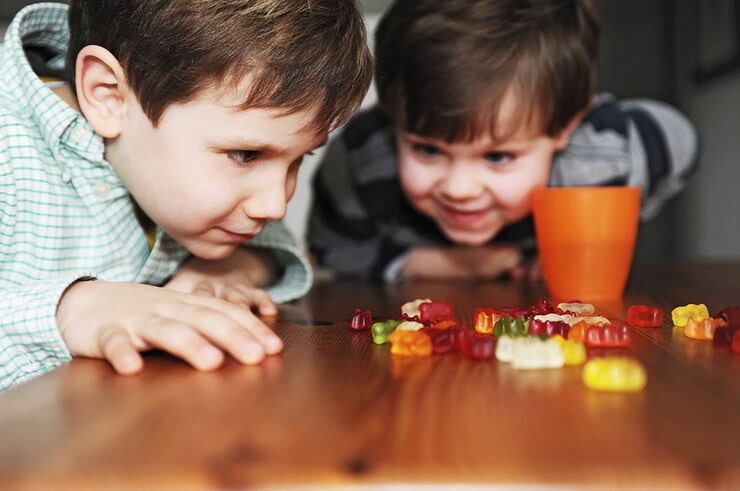
To understand how this develops, McAuliffe and colleagues devised an experiment called the Inequity Game. In the game, one child gets four sweets and another gets one. The child with one can pull a green lever, meaning they both keep their sweets, or a red lever, so that all the sweets tip into a bowl and neither get any.
Many children as young as four would rather forgo their sweet than see another child have more. Children learn early to reject an unfair deal, even when it comes at a personal cost.
In this early stage of developing a sense of fairness, McAuliffe explains, children protect their own self-interests. This is called ‘disadvantageous inequity aversion’, the objection to getting less than others.
As children get older, they begin to consider what others get too, and can look beyond their own interests. In another version of the Inequity Game, the child with more sweets makes the decisions. From around the age of eight, children make sure everyone has an equal amount even if it means throwing some of their own away. I saw this ‘advantageous inequity aversion’ when my own children counted their Halloween bounty and realised one had more – they were happy to discard sweets to ensure they each had the exact same amount.
This sense of fairness is closely tied to a child’s theory of mind, which is their knowledge that the mental states of others may differ from their own. Children who were better at taking another person’s perspective were more likely to act on this more costly form of fairness. In other words, the more your child can imagine how it feels to have only one sweet, the more likely they are to give theirs away if they have more.
“Children who were better at taking another person’s perspective were more likely to act on this more costly form of fairness.”
This is important for how society functions, McAuliffe says. “Advantageous inequity aversion plays a key role in cooperation. When children and adults can give something up in the name of fairness, it signals to others that they’re a trustworthy partner,” she adds.
From an evolutionary perspective, sharing equally could have served a crucial purpose for our survival. The late primatologist Frans de Waal and Sarah Brosnan of Georgia State University suggest that the drive to sharing fairly is important for protecting relationships in order to ensure others cooperate with you in the future.
Understanding fairness and rejecting unequal rewards is also important for children’s developing morality. By around six, they step in to punish unfairness between others. “They’re enforcing it not just when they’ve been affected,” McAuliffe says, “but because they think it ought to apply to everyone.” Alongside this, children also start to understand that some people may need more than others because they have less to start with, and so they are more likely to share with those who have less.
As frustrating as it may be for parents when children fuss over one having a millilitre less milk in their glass, this type of comparison may help them form the foundation of a strong moral code.
Author