Une éducation à la robotique centrée sur les jeunes
What happens when robotics learning begins with youth voices?
Auteurs


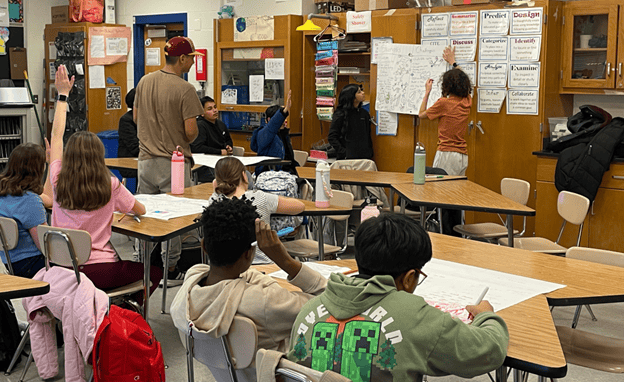
Schools around the world are expanding robotics education, focusing mostly on technical skills such as coding accuracy and mechanical precision. When we designed our after-school robotics program, we started from a different place: We incorporated three core elements – the voices of young people, hands-on robotics, and apprentissage social et émotionnel. Instead of centering the machine, we center young people, their communities, and the purpose behind their work.
“Instead of centering the machine, we center young people, their communities, and the purpose behind their work.”
Robotics helps young people understand and improve the world
Our program, Co-Learn Code and Mind, was developed with five middle schools that are part of Montgomery County Public Schools in the US state of Maryland. Students work in mixed-ability teams supported by teachers, university mentors, community volunteers, and high school peer leaders. The program does not begin with a robotics challenge, but instead with students raising questions that matter to them. They reflect on their daily experiences and then begin to design robotics projects inspired by those reflections.
Our goal is to support young people in building Compétences STIM while also cultivating a sense of belonging, curiosity, identity, collaborative problem-solving, and agency. These competencies lie at the heart of transformative social and emotional learning, in which young people and adults build strong, respectful, and sustained relationships to engage in co-learning. We see learning robotics not as an end in itself, but as a tool for young people to understand and improve the world around them.
From the first week of the program, our team kept a shared journal to help us identify patterns and learn from the students. Our early insights are now shaping the direction of the program.
“We see learning robotics not as an end in itself, but as a tool for young people to understand and improve the world around them.”
Students express themselves in different ways
Many students from under-resourced or marginalized communities enter our program with fewer experiences of expressing their ideas or sharing personal reflections, often because their voices have been overlooked or because they have felt vulnerable or unsupported when they have spoken up in the past. Recognizing this issue, we have sought to create multiple ways for students to express themselves. Those might include engaging in drawing, building, photography, or movement before speaking aloud. Over time, these forms of expression have helped students find language for expressing their ideas and given them confidence in sharing their perspectives with peers and adults.
We learned that when students sense that their insights matter, they participate in new ways. They step forward not only as robotics learners, but as researchers and designers. We found that students’ voices became more confident when we intentionally asked about what concerns them, what brings them joy, or how they experience belonging.
Hands-on robotics provides powerful experiential learning
The moment students begin sketching ideas, connecting wires, coding motors, or testing structures, the energy in the room changes. Students collaborate with enthusiasm, help one another troubleshoot, and are resilient in dealing with setbacks. The physical act of building leads to thoughtful conversations about who they are designing for and why their ideas matter, giving their work meaning.
“Through these physical experiences, students see themselves as creators of knowledge, not just participants in a program.”
We observed that students are conscious of their learning when they build, test, revise, and try again. This encouraged us to experiment with other active and tangible approaches. Students go on walks around the school, capturing their daily experiences with photos and voice notes and designing physical or visual displays to represent what they observe. They move between hands-on cycles of investigation and building. We call this experiential youth inquiry, and it brings together investigation and engineering in a way that feels natural to students. Through these physical experiences, students see themselves as creators of knowledge, not just participants in a program.
Centering youth experiences is essential, but also complex
Should we allow students to build what excites them most? Our answer is yes, although we encourage thoughtful reflection as they choose a project. We want robotics to be joyful, exploratory, and creative. At the same time, we want students to discover how their creations might support people or respond to situations in their school. Some students make these connections easily; others need more time, structure, and encouragement before they can link engineering work with their community observations. Helping students find this balance is one of our most important responsibilities.
Student motivation shifts over time
Many students join the program because robotics is engaging and hands-on, and to take advantage of opportunities to showcase their work. Once students realize that their ideas are helping to shape the project, their motivation becomes more internal. Quiet students begin to speak with confidence and students who joined the program to build robots lean into discussions about school climate, friendship, or fairness. We have seen time and again that using their voices turns external motivation into internal motivation, and that students feel more ownership when they see their ideas take shape.
“Using their voices turns external motivation into internal motivation, and that students feel more ownership when they see their ideas take shape.”
Social and emotional learning is dynamic
Our reflections have reshaped how we understand social and emotional learning. It is not about a set of outcomes, but a dynamic process that can be fostered through robotics education. Students’ identities evolve as they bring their own experiences into the design process. They achieve a sense of belonging as they navigate disagreements and celebrate progress within their teams. They become more collaborative as they rely on one another’s strengths. They show curiosity when asking questions about their community and the challenges they are tackling in their designs. They practice agency by shaping their projects and their research. These elements are woven throughout the program. Students learn to critically examine factors that contribute to inequities, and create collaborative solutions that promote personal, community, and societal wellbeing.
These early insights show that robotics education does not have to be only about technical mastery. It can build relationships, a sense of belonging, curiosity, and purpose. When young people are treated as active thinkers, observers, and co-designers, robotics becomes a pathway for understanding themselves, noticing their environment, and imagining how they might contribute to their community.
As our program grows, we will continue to seek answers to this fundamental question: What becomes possible when young people use robotics not only to build objects, but to explore and improve the world around them?
Auteurs
Notes
Connectez-vous avec nous sur LinkedIn for Co-learn Code and Mind program updates, community highlights and the opportunity to engage.