What do children learn when they teach?
Teaching others allows children to take on different social roles and follow different learning paths
Autor

Socio
Intercambio de redes de variabilidad de aprendizaje
El Intercambio de Redes de Variabilidad del Aprendizaje (LEVANTELEVANTE busca comprender cómo los niños crecen, aprenden y se desarrollan en diferentes épocas, lugares y contextos, para así brindarles el apoyo necesario para que prosperen en la multitud de experiencias que encontrarán a lo largo de su vida. Reúne a investigadores de todo el mundo para crear el primer conjunto de datos abiertos, multidisciplinario e intercultural, cuyo objetivo es capturar la riqueza y diversidad del desarrollo y el aprendizaje infantil. Al incluir la recopilación de datos de medidas comunes en estas diferentes áreas de forma longitudinal y a nivel global, LEVANTE ayudará a investigadores, educadores y responsables políticos a comprender la variabilidad del aprendizaje y el desarrollo, mejorando así los resultados futuros para diversos grupos de niños en todo el mundo.

Children are usually seen as learners. Yet in every classroom they also teach: They explain ideas to one another, correct misunderstandings, and help their peers grasp new concepts. These informal teaching moments may influence how children learn.
Teaching may prompt children to reflect on their own thinking, and it may also encourage them to regulate their own learning strategies.
What happens when children teach
Explaining an idea requires organizing one’s thoughts, identifying what is essential, and anticipating what another person might not understand. This process may push learners to examine their own reasoning more carefully. As children explain their thinking, they may notice gaps or inconsistencies in their own understanding. They may also try to clarify ideas in ways they had not considered before. This approach may cause children to reflect on their own thinking in a process known as metacognición. It could also involve self-regulated learning, or learning-to-teach oneself, in which learners monitor and adjust their strategies while learning with others or by themselves.
These processes may not occur in the same way for every child. Some learners could benefit more from explaining ideas, while others may learn more by asking questions, listening, or challenging a peer’s explanation.
“Teaching may prompt children to reflect on their own thinking, and it may also encourage them to regulate their own learning strategies.”
What’s more, the same child might approach a problem differently depending on whether they are solving it alone, explaining it to someone else, or teaching a peer. Each role may place different cognitive demands on the learner and may shape how learning develops over time.
Learning from adults versus learning from peers
Our research group in Argentina studies how children teach each other and themselves, and how they learn during these interactions.
En una de nuestros estudios, seven-year-olds learned from an adult how to program simple tasks using visual programming tools. After learning how to program the tasks, some children reviewed the material alone, while others were asked to teach what they had learned to a classmate. We then asked the members of two groups – the children who had been taught by an adult and those who had been taught by a peer – to carry out a programming task.
Interestingly, the two groups approached the task in different ways. Those taught by a peer tended to move through the activity more quickly and were less likely to become stuck trying to perfect a single answer. Instead, they continued exploring the task even when their responses were not yet entirely correct.
Overall, the performance of the two groups was similar. However, they chose different paths to complete the task. Those who had learned from a peer were more likely to take an exploratory approach, while those who had been taught by an adult proceeded in a more deliberate and structured way. This suggests that learning outcomes don’t tell the whole story.
En un estudio we ran in Argentina’s tropical region, children learned about dengue prevention. Some of the children were then asked afterwards to use a booklet to explain what they had learned to their parents, while others reviewed the information alone. We found that the adults learned effectively, and the children’s own understanding remained more stable over time than the understanding of other children who had merely reviewed the material on their own. Simply teaching others helped children consolidate their own learning as they also shared useful information with their families.
Why encouraging children to teach their peers could matter in the classroom
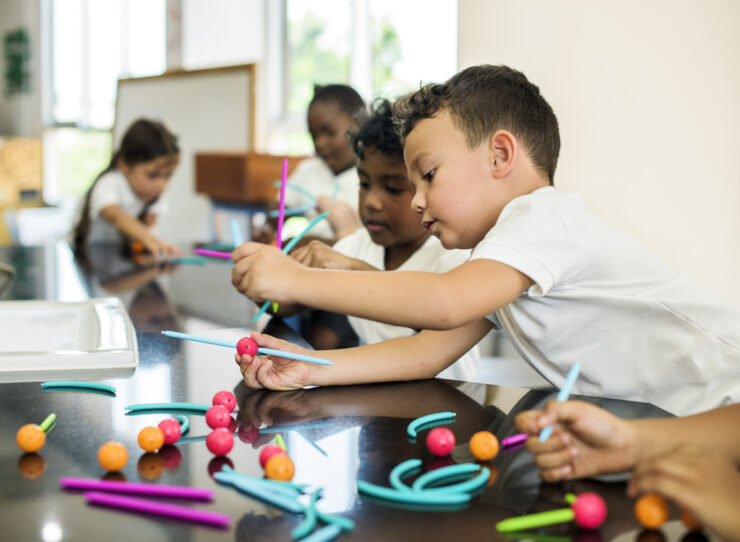
Classroom learning is not an individual activity. Children are constantly observing one another, exchanging ideas, and responding to the reasoning of their peers as well as their teachers. Encouraging children to explain their ideas or teach others can create new opportunities for learning.
“Encouraging children to explain their ideas or teach others can create new opportunities for learning.”
Tutoría entre iguales and activities that help students learn to teach others could help them to articulate their reasoning and engage more actively with the material. These interactions may also expose children to different perspectives, prompting them to compare ideas and refine their understanding. They are low-cost opportunities to gain a deeper understanding that can be adapted across educational contexts. Recognizing that not all children respond to such practices in the same way, may help educators create learning environments that support diverse learning trajectories.
Research programs such as our Little Teachers Project are designed to shed light on how peer tutoring and learning to teach can influence children’s learning processes. In studying how children alternate between the roles of learner and teacher, we seek to understand how interactions between teachers and learners shape learning and how they might support more inclusive and adaptive educational environments. When children teach, learning can take new and sometimes unexpected paths.
Autor
Socio
Intercambio de redes de variabilidad de aprendizaje
El Intercambio de Redes de Variabilidad del Aprendizaje (LEVANTELEVANTE busca comprender cómo los niños crecen, aprenden y se desarrollan en diferentes épocas, lugares y contextos, para así brindarles el apoyo necesario para que prosperen en la multitud de experiencias que encontrarán a lo largo de su vida. Reúne a investigadores de todo el mundo para crear el primer conjunto de datos abiertos, multidisciplinario e intercultural, cuyo objetivo es capturar la riqueza y diversidad del desarrollo y el aprendizaje infantil. Al incluir la recopilación de datos de medidas comunes en estas diferentes áreas de forma longitudinal y a nivel global, LEVANTE ayudará a investigadores, educadores y responsables políticos a comprender la variabilidad del aprendizaje y el desarrollo, mejorando así los resultados futuros para diversos grupos de niños en todo el mundo.
Notas a pie de página
Este artículo forma parte de una serie en colaboración con LEVANTE, la Red de Intercambio de Variabilidad del Aprendizaje. LEVANTE es una red de investigación global que está mejorando nuestra comprensión de la variabilidad a través de la recopilación coordinada de datos a gran escala. Cada artículo presenta el pensamiento científico más reciente de uno de los sitios de investigación de LEVANTE. LEVANTE es una iniciativa de la Jacobs Foundation.