The developmental psychologist aligning brain and body in math learning
How physical learning experiences support children’s mathematics development
Interviewee:

Interview by:

Jenny Yun-Chen Chan studies how young children build math skills through physical experiences. Annie Brookman-Byrne finds out more.
Annie Brookman-Byrne: Why do you study the physical side of mathematics learning?
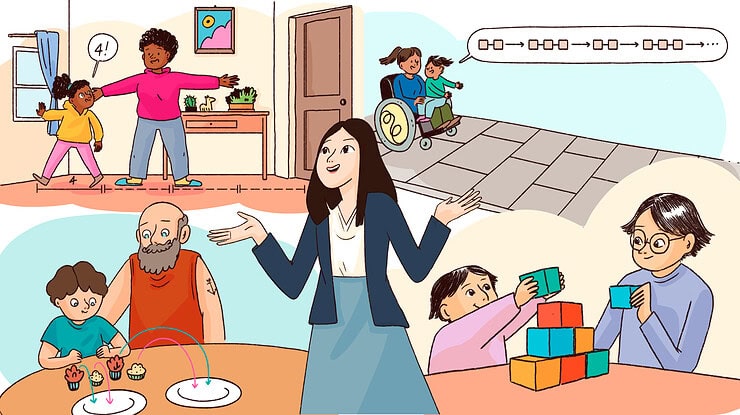
Jenny Yun-Chen Chan: Our thinking is deeply rooted in our physical interactions. For a young child, math isn’t just abstract symbols on a page; it is felt through the weight of blocks, the rhythm of a song, or the movement of a game. This is known as embodied cognition. By understanding how these physical experiences scaffold mathematical reasoning, we can design learning environments that align with how a child’s brain and body naturally work together.
Foundational math skills like understanding patterns and relations are a fundamental gateway to future innovation and technology. However, many current educational tools aren’t built for the reality of a busy home or a diverse classroom.
To ensure scientific insights work in the real world, I create tools with parents and educators, rather than just for them, through participatory design. This collaboration ensures our tools are evidence-backed yet feasible, usable, and enjoyable to families. The co-design experiences can also empower caregivers to see mathematical moments everywhere and transform what they do with their children.
Ultimately, I am building a supportive community of researchers, educators, and families. By making high-quality learning accessible to everyone—regardless of their background—we ensure that all children have an equitable opportunity to build the foundations they need to thrive in a changing world.
“For a young child, math isn’t just abstract symbols on a page; it is felt through the weight of blocks, the rhythm of a song, or the movement of a game.”
Annie: What are the biggest challenges in researching mathematics learning?
Jenny: There is a ‘translation gap’ between laboratory findings and integrating them into the messy reality of a family’s home. This is further complicated by AI and technology. While rapid technological advances offer adaptive tools that can personalize learning at scale, digital tools might lead to passive screen time or replace meaningful human interaction. Furthermore, interventions are often designed around the assumption that caregivers, especially those in under-resourced communities, lack the skills or knowledge to support their children.
To address these challenges, I leverage the inherent strengths, cultural wisdom, and existing practices of parents and educators to design embodied tools that enhance caregiver-child engagement and keep math learning physical and interactive. I am committed to ‘slow science,’ often listening, observing, and iterating alongside families to co-design tools over months. Balancing this approach with the fast-paced demands of academia and the real world is a constant tension. However, this approach helps ensure that our work is not just evidence-backed, but truly feasible, culturally resonant, and joyful for the families it serves.
Annie: How will your research ultimately help children?
Jenny: In our changing world, the ability to think flexibly and solve complex problems is more critical than ever. I am shifting the instructional focus from rote memorization to building a deep, intuitive foundation for mathematical reasoning. By anchoring abstract concepts like patterns, symmetry, and proportions in physical actions, children learn to think with their whole selves. When this is layered with the joy of play and social interaction, math becomes a shared language of discovery rather than an isolating task.
Furthermore, as AI and digital tools become ubiquitous, my research informs the design of tools that encourage movement and social engagement rather than passive consumption. A child’s ability to thrive depends on the strength of their support system. By empowering caregivers and educators to see themselves as capable co-designers of learning, we create a stable, nurturing ecosystem. This collective empowerment ensures that all children, particularly those in underserved communities, have the confidence, agency, and foundational skills to navigate and lead in an increasingly complex world.
Annie: What advice do you have for caregivers and educators?
Jenny: Math is not a quiet, desk-bound activity—it is a physical, social, and joyful experience that is already happening all around you. You simply need to notice and name the math that is hidden in your daily routines. Here are four strategies from our research that you can use today:
1. Embody the concept
Since thinking is rooted in action, let children physically feel the math. If you are talking about patterns, create a physical rhythm together (stomp-clap-stomp-clap). If you are discussing measurement, use your bodies to see how many steps it takes to cross the room.
2. Follow the play
Look for the mathematical possibilities in the games your child already loves. In our studies, we found that different toys spark different types of math talk. For example, playing with blocks naturally encourages families to think about spatial relations, while play-kitchen sets are fantastic for exploring arithmetic and sharing.
3. Ask “How can we…?” instead of “How many?”
Move beyond simple counting by asking questions that spark reasoning. For example: “How can we share these blueberries, so everyone gets the same amount?” This invites children to explore complex ideas like division and equality through a real-world problem they care about.
4. Unveil the math
We believe that the most effective learning tools are those that fit seamlessly into your life. Whether it’s counting out ingredients while cooking or spotting patterns on a sidewalk, your role is simply to unveil the math that is already part of your routine. When you see a mathematical spark, name it and explore it together.
Through these small interactions, you transform daily tasks into a shared language of discovery, empowering your child to see themselves as a capable problem-solver.
“Math is not a quiet, desk-bound activity—it is a physical, social, and joyful experience that is already happening all around you.”
Annie: What are you excited about in education research?
Jenny: The rise of participatory design in creating human-centered tools is truly energizing. Researchers are now co-designing tools with caregivers and educators. This partnership ensures that new tools—including AI and digital platforms—don’t replace human interaction, but rather act as a bridge to it. By creating tools that are grounded in the real-world needs of users, we ensure that technology supports physical play and deepens social connection, making it a helpful partner in the home and classroom.
The concept of ‘glocalization’ is a transformative frontier. This is the strategic blending of global educational trends—like playful learning—with local cultural values, traditions, and contexts. This approach moves us away from one-size-fits-all solutions and empowers caregivers to leverage their own cultural strengths and stories. By blending the best of global research with local wisdom, we are building a more equitable world where every child, in every context, has the opportunity to thrive.
Footnotes
Jenny Yun-Chen Chan is Assistant Professor & Associate Head (Internationalization) in the Department of Early Childhood Education at The Education University of Hong Kong. A 2026-2028 Jacobs CIFAR Research Fellow, she holds a PhD in Developmental Psychology from the University of Minnesota and completed postdoctoral training in Learning Sciences and Technologies at Worcester Polytechnic Institute, USA.
Jenny’s research investigates the mechanisms of math learning to inform the participatory design of educational interventions. She currently serves on the Governing Board of the Mathematical Cognition and Learning Society and Editorial Boards for Cognitive Development and the Journal of Cognition and Development.
Jenny’s website, and Jenny on X, Bluesky, and LinkedIn.
This interview was edited for clarity.