How do children develop spatial reasoning?
Children, like adults, use one of two strategies to solve mental rotation problems
Author

Spatial reasoning is a key building block for developing skills in mathematics, geography, science, engineering, technology, and even biomedicine. Mental rotation is a particularly important spatial skill.
“Mental rotation is a spatial skill that we use for just about everything,” says Karinna Rodriguez, doctoral candidate in developmental science at Florida International University in Miami and the lead author of a new study on children’s mental rotation. “It’s the ability to rotate objects mentally in our minds without physically grabbing something and turning it,” Rodriguez tells me. “We use it when we’re trying to interpret maps, build puzzles, put away groceries in the pantry – any time we’re trying to figure out the best methods of how to, basically, place things into holes.”
“Mental rotation is a spatial skill that we use for just about everything.”
Karinna Rodriguez
But how, exactly, children develop this skill – and which tactics they use for mental rotation – has remained a mystery. Rodriguez and other researchers based at the university’s Center for Children and Families got closer to understanding children’s problem-solving strategies by tracking children’s eye movements.
How do children mentally rotate objects?
While scientists already knew that at least some children as young as three could mentally rotate objects, it was less clear how they were doing so. Understanding this cognitive process could help educators better support children in learning how to mentally rotate objects and also help them identify children who are struggling early, before a weakness in this area affects their math or science achievement.
“While scientists already knew that at least some children as young as three could mentally rotate objects, it was less clear how they were doing so.”
But simply asking children what strategies they’re using rarely elicits a helpful answer. “They can’t really reflect, at that age, on how they’re solving things and then verbally describe it,” says Shannon Pruden, psychology professor and director of the Project on Language and Spatial Development at Florida International University in Miami, and one of the study’s co-authors. The researchers saw eye tracking as an exciting way to understand children’s problem-solving. “Could we use their eye gaze data, their very precise eye tracking data, to figure it out?” Pruden asks.
First, the research team brought a portable eye tracker to a preschool to record where children were looking, and for how long, while completing a mental rotation task. Although this was a useful pilot initiative, the scientists quickly realized that they needed to see more children and collect more data. A larger sample size would allow them to mitigate concerns about missing or incomplete data, and to detect a small to moderate effect.
They partnered with a science museum in Miami, where they set up the task in a children’s exhibition. Families who passed by were invited to participate. The researchers gathered data from 148 children aged three to seven years old.
In the experiment, children were shown pictures of one large and two small objects, such as trucks. One small object faced the same way as the large object, while the other faced in the opposite direction. The two small objects were oriented at different angles to the large object. The children were asked which small object “matched” the large one. The correct answer was the one facing the same way. While the children looked at the pictures to figure it out, the researchers tracked where they were looking. Each child performed the task using 10 different pictures.
Different children use different mental rotation strategies
Children fell into one of two camps: Some solved the problem using a holistic strategy, first looking at the whole image and then rotating it visually. Others used a piecemeal strategy, looking at individual parts of the image and then finding the pieces that matched.
This is surprisingly similar to the methods used by adults to solve the same problems. The proportion of children using each strategy was roughly the same as in adults: about 85% of children used the holistic strategy, compared with 71% of adults in a 2019 study.
“That was striking to us,” says Pruden. “Like, wow, there are little kids – three-, four-year-olds – already visualizing the whole image and mentally rotating it, instead of just looking at individual parts of the image.”
There was no difference in accuracy between the two groups. But the children who used the holistic strategy solved each problem more quickly, taking 8 seconds, on average, versus 14 seconds for the piecemeal strategy.
That doesn’t mean the holistic strategy is necessarily better, as speed is just one metric. It’s possible that certain outcomes they didn’t measure, such as how well children remembered the design of the objects, might have been better with the piecemeal strategy.
Pruden’s research with adults has found that switching between strategies can be especially useful – the adults who did this responded more accurately than those who did not. A next step for the team is to examine whether children, too, are able to switch between strategies.
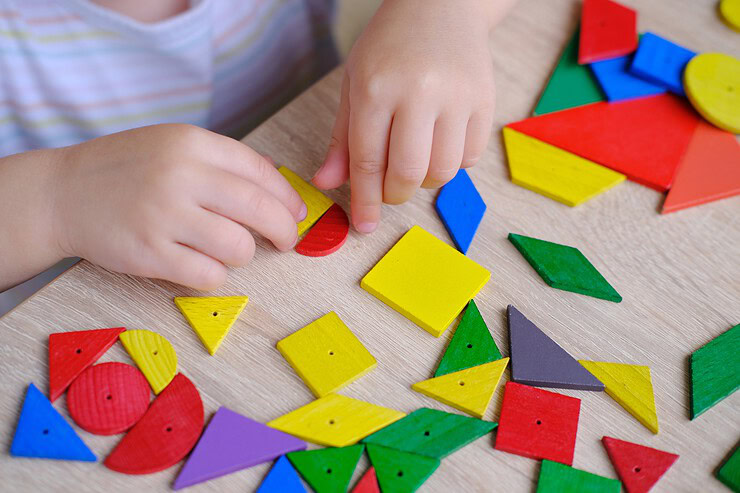
For now, the team hopes that their work will show educators and families how important it is to support children’s spatial skills. Caregivers and educators might join children in playing with spatial toys like blocks or tangrams or use spatial language, for example talking to kids about shape, size, and distance.
“We want educators to know that children have very sophisticated problem-solving abilities.”
Shannon Pruden
“We want educators to know that children have very sophisticated problem-solving abilities. That’s not something that we had evidence for before,” Pruden says. “Kids are ready to absorb this kind of spatial information – and that means giving them opportunities to engage and spatial tasks to play with.” Ultimately, building those spatial skills will help set children up for success.
Author