Does pretend play support young children's mental health?
Toddlers' imaginative play is linked to fewer emotional and behavioural difficulties later on
Authors


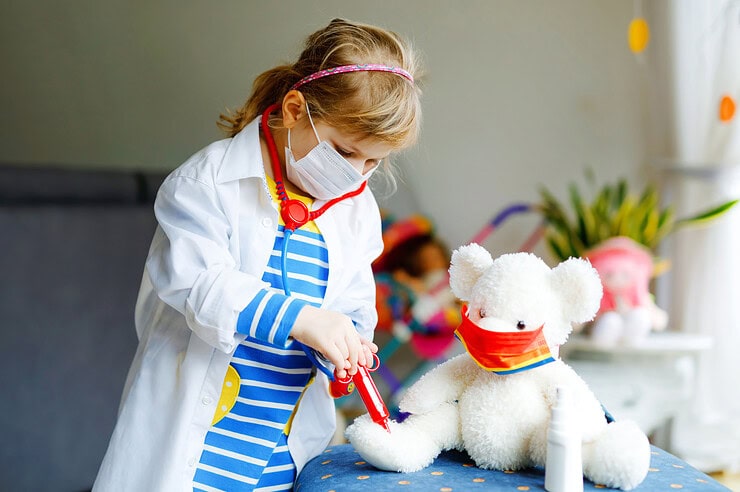
For young children, a cardboard box can be a rocket, a towel can be a superhero’s cape, and a row of cushions can be a bus full of passengers. Pretend play is one of the most familiar features of early childhood, and children can learn from this kind of play. Our new study suggests it may have even more benefits. We have found links between pretend play in the toddler years and better mental health several years later.
Pretend play and mental health over time
Children typically begin to engage in pretend play in the second year of life, and it becomes more elaborate as they grow older. By age four or five, children often incorporate invented characters, unfolding storylines, and other children in their play. We wondered whether this ordinary, enjoyable, everyday activity is connected to later wellbeing. Mental health difficulties affect around one in seven children, yet most prevention efforts are aimed at older children and adolescents, after problems have already begun to emerge. What if pretend play could support children in the earliest years, before difficulties take hold?
To explore a possible link, we looked at data from 1,426 children, collected over time between toddlerhood and the early primary school years. When the children were two and three years old, their educators rated three kinds of pretend play. They judged how well the children were able to engage in simple pretend play, such as feeding a doll; how well they could use one object to represent another, such as a box for a house; and how well they could engage in pretend play with peers, for example dressing up and playing house together. Mental health, in terms of emotional and behavioural difficulties, was assessed by educators and primary caregivers when the children were ages four and five and again at ages six and seven.
“We have found links between pretend play in the toddler years and better mental health several years later.”
What we found was consistent with our expectations. Children who were more adept at pretend play as toddlers tended to experience better mental health later on. They had fewer emotional difficulties, such as worries, fearfulness, or a need to withdraw, and fewer behavioural difficulties, such as temper tantrums or difficulty settling down. This was reflected in reports from both educators and parents, and was true at both older ages.
The link between pretend play and mental health was still evident even after we accounted for the family’s socioeconomic status, the mother’s mental health, the child’s language ability, and the security of the child’s relationship with a parent. Since these factors are associated with child mental health, we have confidence that our findings are meaningful and not simply explained by those factors.
Because we analysed existing data instead of running an experiment, we cannot say that pretend play caused better mental health in these children. But our study is a promising start, and to our knowledge it is the first to link pretend play to mental health over time. Our findings are in keeping with related earlier work indicating that playing with peers can protect children’s mental health.
Why might pretend play support mental health?
Our initial assumption was that the main reason for the positive impact of pretend play had to do with emotional regulation. The idea is intuitive: pretend play gives children a safe space to rehearse difficult feelings, so children who are good at pretend play might become better at managing their emotions, which in turn would support their mental health. However, we found no evidence that emotional regulation was the key factor.
We are exploring other ideas. Pretend play is a physical, whole-body activity. When children sweep the floor with an imaginary broom or steer an imaginary car, the motor regions of their brains are active, and some of these same regions are linked to both anxiety and attention. It may be that the physical nature of pretend play, too, plays an important role in later wellbeing. However, so far this is merely a hypothesis and part of ongoing work on ‘embodiment’, which is how movement and the body shape children’s thinking.
“Children who were more adept at pretend play as toddlers tended to experience better mental health later on.”
What does this mean for the adults who interact with young children every day? We don’t yet know why pretend play may support mental health, but it is clearly worth protecting the conditions that allow pretend play to flourish.
How educators and families can support pretend play
- Make room for unstructured, child-initiated play, and resist the urge to fill every moment with a planned activity.
- Follow the child’s lead. Gentle, responsive involvement tends to extend pretend play, whereas directing it can shut it down.
- Offer open-ended materials, such as boxes, fabric, blocks, and everyday objects, that invite children to imagine one thing as another.
- Encourage play with peers, including dressing up and roleplay, which promotes social skills as well as imagination.
- Resist attaching a learning goal to every play activity. When play is focused too much on outcomes, this may have an adverse effect on children’s freedom to pretend, and compromise the benefits that may come with pretend play.
There is still much to learn. We need studies to test whether supporting pretend play can improve children’s mental health, and we need a better way of measuring play than a short questionnaire. But the direction of our findings is hopeful. One of the most natural things children do, pretending that a rock is a spaceship or that a pen is a fairy, may also help lay the foundation for a healthy mind.
Authors
Footnotes
Sasha Bailey, Louise Birrell, Iroise Dumontheil, Gill Francis, Eliza Oliver, Olivia Karaolis, Robyn Ewing, Michael Anderson, Maree Teesson and Emma L. Barrett were also authors of the research study discussed in this piece.