« Le bien-être psychosocial est nécessaire pour atteindre son plein potentiel. »
Interview par :

Noreen Huni, founding Executive Director and CEO of REPSSI, talks about helping children in sub-Saharan Africa learn to feel good about themselves.
Caroline Smrstik Gentner : Your organization, REPSSI, is serving 13 countries in sub-Saharan Africa. What are some of the obstacles in common that children face in your region?
Noreen Huni: HIV and AIDS, and their linkage to poverty is the major challenge in our region. That’s what prompted us to start working in the most vulnerable communities: looking at the children’s social and emotional wellbeing in the context of HIV and poverty. Children are being left behind. Whenever I hear the safety announcements in the airplane (“Put your mask on first, then assist the child next to you.”), I realize it’s like that with anti-retroviral drugs. For most adults living with HIV, it has been all about “me, me, me first: I must get the treatment, I must survive”. Which is fine.
But that has led to very slow responses for the children. In all these countries, investment for children who are HIV-positive, and children in general, is very low.
Another common challenge is child marriage, which we believe is triggered by the economic status of individual families. Child marriage leads to teen mothers. How do you prepare a teen mother to look after herself, and to look after her new-born baby?
CSG : Why did your focus shift more to early childhood development themes?
NH: Lorsqu'on se rend dans une communauté, on voit des enfants. On ne voit pas « des enfants séropositifs ». On voit simplement des enfants. La petite enfance est un excellent point de départ pour répondre aux difficultés rencontrées par les enfants. Mais lorsqu'on commence à interagir avec eux, on prend conscience des difficultés qu'ils vivent et de leur incroyable résilience. Avec un soutien plus ciblé, ces enfants s'épanouiraient pleinement.
“It is important to equip a child with the appropriate knowledge, skills, and resilience factors that can help them to navigate milestones as they develop towards adolescence and adulthood.”
That’s what made us strengthen our work on early childhood development, because we realized that most of the interventions and support with our projects came too late in a child’s life.
Difficult as it may be to talk about AIDS, HIV prevention, or sexual and reproductive rights and issues to children, we need to keep challenging ourselves to do so. It is important to equip a child with the appropriate knowledge, skills, and resilience factors that can help them to navigate milestones as they develop towards adolescence and adulthood.
CSG : What’s your definition of psychosocial wellbeing?
NH: In my view, it is when you feel loved, when you feel accepted, when you feel encouraged, secure, and you have a sense of belonging. When you feel that you are free to express yourself and you feel good about yourself. In addition to that, you feel you are able to access the resources, skills, and knowledge that you want in order to thrive.
To me, psychosocial and mental wellbeing are the primary protective factors for positive social development, educational and health outcomes. One needs these protective elements to realize one’s full potential, not just to survive, but to thrive.
CSG : What can your organization do to foster psychosocial wellbeing?
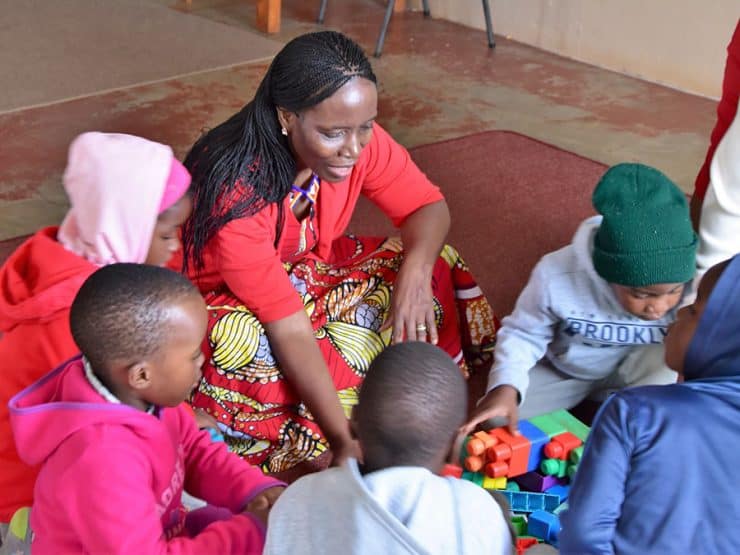
NH: Aside from working with the parents or primary caregivers, and with everyone else who supports the caregivers, we encourage Apprentissage expérimentale. For children, being exposed to what we call “peak moments” helps – being able to manage peer pressure, how to praise others, being able to see what is good in others, being able to laugh together – all those things can improve a child’s psychosocial and mental wellbeing.
CSG : You mentioned once that adults failed to listen to children. Explain to me why you think that is neglected.
NH: In our context, children are never asked for their opinion! It can be very difficult to ask a child “what do you think?” We never give them that opportunity. When we work in communities, we therefore encourage our partners to use all their senses to find out what children think or need: What do you hear when the child says something? What do you see in a child? If a child is being abused, can you see that? What do you feel when you touch a child? If you just extend a hand to say hello, you may notice the child’s temperature is too high. Your sense of smell – if a child is being sexually abused, is neglected, you can smell that.
“Psychosocial and mental wellbeing are the primary protective factors for positive social development, educational and health outcomes.”
Caregivers must see a child as more than “just a kid”. Every child is a person with full human rights, who can communicate to us and express in a variety of ways how they are feeling or what they are going through.
CSG : Do you feel like a lone voice advocating for more structured early childhood development?
NH: It sometimes feels lonely! The level of engagement for early childhood development (ECD) is very low across the region. The ministries that support children or provide services to vulnerable communities are poorly resourced. South Africa has taken some positive strides, but in other countries ECD begins with toddlers and ignores the first 1000 days of life. There’s nothing on responsive care, early learning and early stimulation for children.
“Every child is a person with full human rights, who can communicate to us and express in a variety of ways how they are feeling or what they are going through.”
Malgré toutes les preuves concernant le développement cérébral et la justification économique d'investir dans la petite enfance, les actions concrètes visant un impact significatif restent insuffisantes. À mes yeux, il s'agit d'une occasion manquée de plus pour développer un capital humain productif.
Interview par :
Notes
Noreen Huni is CEO and founding Executive Director of REPSSI, une organisation qui intègre le soutien psychosocial dans les programmes et services destinés aux filles, aux garçons et aux jeunes d'Afrique de l'Est et australe. Elle fait partie des dix Lauréats des prix Klaus J. Jacobs 2018 qui est décernée aux innovateurs sociaux et aux acteurs du changement dans le domaine du développement de l'enfant et de la jeunesse.