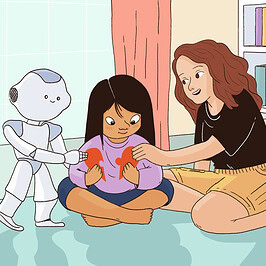
The cognitive scientist tracking kids’ theories about the world
How do children revise their theories when they encounter new evidence?
Interviewee:
Interview by:
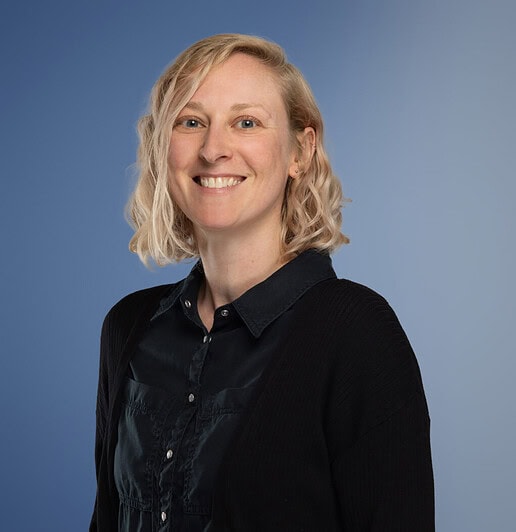
Caren Walker studies how young children learn about the world around them. Annie Brookman-Byrne finds out more.
Annie Brookman-Byrne: Tell me about your research.
Caren Walker: Little kids are the best learners in the known universe. There’s a lot of conceptual change going on during early childhood, so I study that period to understand the mechanisms of learning.
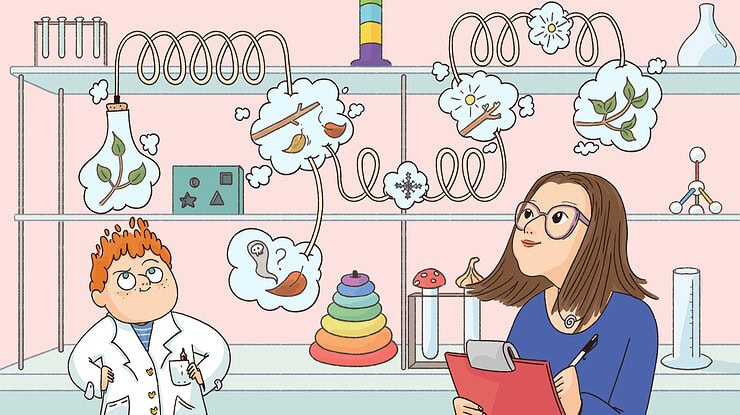
I see the child as a scientist. Theory change during early life is comparable to theory change in science. The child is like the scientist who’s generating theories or hypotheses about the world, and then testing and revising them as new evidence emerges. Children usually generate that evidence for themselves through play, through interacting with other people, or just by observing the world around them, and they revise their theories over time.
Uncertainty is an inherent part of this process, because kids’ theories about the world are incomplete and continually changing. There’s uncertainty in the environment, since whenever we observe something in the world, that observation is consistent with many possible interpretations. So learning takes place under pretty significant conditions of uncertainty all of the time, and I study how children respond to that uncertainty.
“Children usually generate that evidence for themselves through play, through interacting with other people, or just by observing the world around them, and they revise their theories over time.”
Annie: What kind of theory might a child have, and where does the uncertainty come in?
Caren: Very early in life, kids already have a variety of intuitive theories about the world. For example, most children intuitively think that if something moves, it must be alive. This early theory gets them pretty far, because most things that are alive do move. But with new evidence, this theory breaks down: cars move, but they’re not alive; plants don’t visibly move, but they are alive. This introduces conflicting information, as evidence from the world creates uncertainty.
In my lab, we ask what children do with this type of counterevidence. How do they handle anomalous data that doesn’t fit their existing theory? They have options. They can either dismiss it as noise, just a fluke, or they can take it seriously and use it to revise their existing theory.
Of course, there’s a balance between being willing to revise your beliefs so that you can update your theories over time, and changing them so rapidly that you lose a good theory that’s predictive of the world. Our theories are what allow us to act in the world. They help us explain the things we experience and make predictions about things we have never seen before. As long as a theory is working, you don’t necessarily want to abandon it. So there’s a constant question of how much evidence is necessary before overturning an existing theory.
“Little kids are the best learners in the known universe.”
Annie: What’s challenging in this research?
Caren: It’s hard to study little kids. We do it for a reason, but it’s really hard. Even when kids are old enough to talk, they have an extremely difficult time telling you what they think. So we have to come up with clever ways to figure out indirectly how they’re reasoning, what they’re learning, and what they are capable of thinking about.
Also, because early learners are very different from adult learners, it is important to avoid imposing our adult assumptions about the correct answer when we design a task for kids. A child’s answer may be incorrect from the researcher’s perspective, but it can still be informative in the context of the child’s own approach to reasoning. Historically, scholars often underestimated kids, focusing on the fact that they don’t have advanced concepts and can’t reason abstractly. So the history of my field has essentially been a process of designing novel methods that are sensitive enough to pick up what kids know.
For this reason, a lot of the tasks we give children in my lab are gamified. For example, we might show them a toy that plays music when certain objects are put on top of it. We then let them play with the objects, and we interpret their play.
“Simply being asked to generate an explanation, regardless of the content of the explanation, is helpful for children’s learning.”
Annie: How could this research help children?
Caren: In order to be successful in a changing world, you have to be comfortable with making inferences despite uncertainty. You have to be willing to be wrong. You have to be willing to update your beliefs in light of new information. You have to be okay with sitting with uncertainty and experiencing ambiguity, because that’s when a lot of the deep learning and conceptual change happens.
Understanding how children react to uncertainty and how they interpret uncertain information is critical for understanding how they can be flexible, adaptive learners. I hope this research can help us teach kids to treat uncertainty as an opportunity to consider other possible ways the world could be.
Annie: Does this work feed into teaching in schools?
Caren: It does. Unfortunately, formal education often prioritizes and rewards accuracy, speed, efficiency, and productivity. Taking this research to heart does not mean abandoning accuracy completely, but it does mean teaching kids that it’s safe, comfortable, and even desirable to experience some uncertainty, to make mistakes, to explore possibilities. We should show them that it is okay to go down a rabbit hole toward a conclusion that may ultimately be wrong, since the process itself provides a learning experience.
Educators are increasingly paying attention to this idea of productive failure – that it’s okay to make errors. This means fostering an environment where kids feel safe to be unsure and consider it a strength to change their mind, not an admission of failure. But it’s hard to move away from creating a learning context that demands a particular answer.
Annie: Do you have concrete advice for adults based on your research?
Caren: If a child asks you for an answer, try to hold back rather than providing it right away. Ask them to come up with some possible solutions on their own. Simply being asked to generate an explanation, regardless of the content of the explanation, is helpful for children’s learning. It makes their own knowledge visible to them, so they can recognize gaps in their understanding. Searching for a good explanation means looking for broad, generalizable abstractions that they can use to describe their experience. So it’s extremely helpful to prompt kids with questions and ask them to explain, and then explain again.
Annie: What are your hopes for the future of your field?
Caren: Many in my field focus on understanding what kids know. Some of us are also examining the process by which they come to know. I think the move towards understanding differences in learning strategies is a cool and interesting direction for the field to take.
For a long time, I largely ignored differences between individual children and instead focused on looking for universal maxims about how kids learn. Increasingly, I find it intriguing to think about how variations in cognition, culture, experience, knowledge, and temperament wind up leading to differences in learning outcomes, because of kids’ reactions to their learning situations. The field is moving in that direction. It’s harder to study, but it’s fun.
Footnotes
Caren Walker is an Associate Professor of Psychology at the University of California, San Diego and Director of the Early Learning & Cognition Lab. She received her Ph.D. in psychology from the University of California, Berkeley in 2015. Caren’s research is in the area of cognitive development, examining the various learning mechanisms that underlie knowledge acquisition and change. This work addresses basic questions about the nature of mental representations in human cognition, and she is particularly interested in the early development of abstract reasoning about causality.
Read more about Caren’s work on her lab website and Google Scholar, and view her profile on the UC San Diego’s website.
This interview was edited for clarity.