How to support mathematical learning in children with developmental coordination disorder
Children with DCD benefit from more time, more feedback, and a focus on their strengths
Author

If you’re a teacher, you probably know a child who struggles more than others to cut with scissors, tie their shoelaces, or catch a ball. Their handwriting may be slow and messy, or they may seem clumsier than their classmates. These are among the challenges faced every day by children with developmental coordination disorder (DCD), also known as dyspraxia.
What is developmental coordination disorder?
Around 6% of school-aged children have a diagnosis of DCD, which affects their fine and gross motor skills. Their coordination is also impacted, making it harder for them to plan and carry out physical movements smoothly. Although DCD can compromise a child’s wellbeing, affecting their self-esteem, physical fitness, and relationships with peers, the signs of this disorder are frequently missed by parents, teachers, and other professionals. This is often the first barrier these children and their families face – when the disorder is not recognized, they do not receive the support they need. Many families describe feeling frustrated and misunderstood. Raising awareness of DCD and ensuring a prompt diagnosis are key to providing appropriate support and enabling children to have a more successful learning experience.
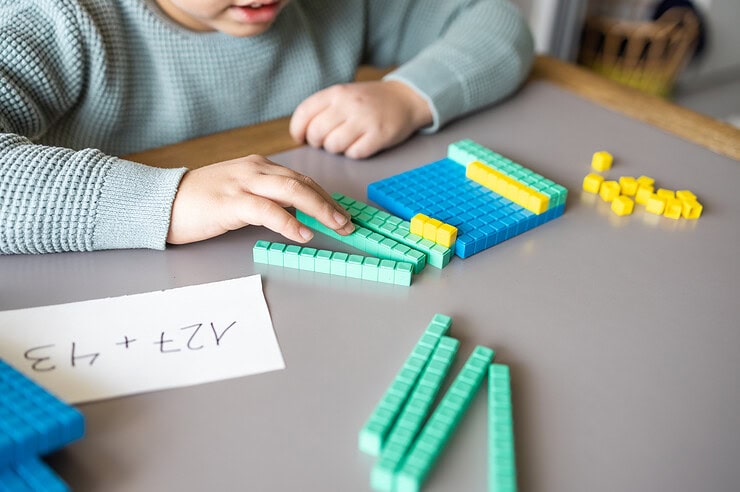
Children with DCD tend to struggle with mathematics, too. In fact, math difficulties are just as common among these children as writing difficulties: an estimated 90% of children with DCD have difficulty with mathematics. Since math is part of daily life – used in scheduling, cooking, managing money – these difficulties can have a lasting impact on a person’s independence and wellbeing, long after the school years are over.
“Raising awareness of DCD and ensuring a prompt diagnosis are key to providing appropriate support and enabling children to have a more successful learning experience.”
Why might a child with DCD struggle with math?
Math skills start developing early, well before children learn to add or subtract. First, children start learning to put things in order, count, estimate how many, and compare quantities – for example, judging which of two bags contains more apples. These early skills are the building blocks for the math that comes later, including more complex topics like fractions. Children with DCD often find these foundational skills harder to grasp, and the gap between them and their peers can persist as math becomes more advanced.
Why would a disorder that affects movement also affect something as abstract as math? Part of the answer lies in shared brain regions. The brain areas involved in planning and coordinating movement overlap with the areas involved in numerical thinking. When one system using a certain brain region develops differently, another system is often affected as well.
“Why would a disorder that affects movement also affect something as abstract as math? Part of the answer lies in shared brain regions.”
Another part of the answer lies in a set of mental skills known as executive functions. These skills allow us to plan ahead, organize the steps of a task, switch between different ways of thinking, and hold onto information that matters while blocking or letting go of what doesn’t. Children with DCD tend to find these skills more challenging, and both their motor difficulties and their math difficulties are affected. Solving a math problem often requires ignoring information that is irrelevant or distracting and focusing only on what helps to solve the task. Children with DCD have a harder time with this kind of filtering than their peers who don’t have DCD.
Math can sometimes require letting go of ideas that used to work but no longer apply and replacing them with new ones. For example, children spend years learning that a number with more digits is bigger, that multiplying always makes numbers bigger, and that every number has a “next” one. But fractions break all these rules: multiplying by a fraction can make a number smaller, and there is no “next” fraction at all. In order to understand fractions, a child has to set aside those old whole-number habits and build new ones in their place. This is a challenging transition for any child, and an even harder one for children with DCD because learning these things requires executive functions.
Supporting a child with DCD in mathematics
With time, children with DCD can learn to filter out distractions, update old strategies, reorganize their knowledge, and perform tasks that ask a lot of their executive functions. Children with DCD can learn just as well as any other child; they may simply need more time, more repetition of the steps that lead to the correct answer, more practice, and more consistent support to get there.
Children with DCD benefit from feedback that is direct, frequent, and focused on their strengths rather than their difficulties. Every child has their own set of strengths, and it is important to identify those strengths in order to support the child’s learning. For example, if a child has solid language skills, it can be helpful to encourage them to talk through the steps to solve a problem out loud. Starting from what they do well can make learning feel more achievable, boost their confidence, and motivate them to attempt harder tasks over time.
“Starting from what they do well can make learning feel more achievable, boost their confidence, and motivate them to attempt harder tasks over time.”
Recognizing that a child’s struggle with fractions may involve the same underlying skills as those required for planning and coordinating movements like tying their shoelaces can change how we teach, how patient we are, and how we help these children build confidence in a subject that will help them throughout their lives.
Author