How to help a young child build executive function
Using language during sorting tasks could support this developing skill
Author

When a 2-year-old in a meltdown hits her mother, her executive function is in the earliest stages of development. When, at five, the same child clenches her fists and shouts that she’s angry, instead of hitting, that’s likely her increased executive function at work.
Executive function describes the cognitive processes that allow us to deliberate rationally, make intentional decisions, work towards goals, and switch between tasks. At its core is the regulation and control of our behavior – rather than simply acting on impulse. As anyone who spends time with children knows, these skills take time to develop. Some children require more support than others in developing executive function; a child with ADHD, for example, often struggles more with some executive function processes, including response inhibition.
Why executive function is important
“It’s an umbrella term for a set of processes that help you basically regulate and control your behavior appropriately in a context,” says Larissa Samuelson, a psychologist who researches cognitive development and early word learning at the UK’s University of East Anglia. Executive function, which is still developing in young children, helps preschoolers and kindergarteners with everyday tasks like sitting in circle time and listening to a book read aloud, Samuelson says. Then, when they go outside for recess, it helps them abide by a whole different set of rules. They’re allowed to run around, for example, but they can’t leave the schoolyard even when it might be tempting to do so.
Good executive function in childhood can provide long-lasting benefits. When children with better executive function reach adolescence, they tend to achieve more academically, engage in less aggressive or criminal behavior and less substance use, and have fewer depressive symptoms. As adults, they’re less likely to use drugs, be unemployed, or even be physically ill. That may be because executive function is key to helping us override impulses in favor of more rational thinking and longer-term planning. For example, we might choose to study for tomorrow’s math test instead of staying out late partying.
“Language helps us attach labels to the world around us, which enables us to apply rules and think flexibly.”
How language links to executive function
Since at least the 1960s, researchers have suspected that language plays a powerful role in executive function development. New research, including from Samuelson, is uncovering one reason why: Language helps us attach labels to the world around us, which enables us to apply rules and think flexibly.
“It’s one of the ways that you group things,” she says. “You can say, ‘These things can all go together, and I can call them by the same label’.”
Categorizing is more important than it might sound – not just for communication, but also for problem-solving and flexible thinking. Imagine, for example, that you need to jot something down but can’t find a pen. You might find something else from the broader category of writing utensils, like a pencil or a marker. Without an awareness of that grouping, you can’t make an appropriate substitution.
While it sounds simple, this skill requires complex thinking. Pens are usually long and thin. But when we find ourselves without one and needing to write, we can’t substitute just anything of a similar shape – we’re not going to have much luck with a chopstick. Yet under different circumstances, say a marble has rolled under the couch and we need something to retrieve it, the shape might be important, and a chopstick will probably do.
Learning words that describe different characteristics seems to impact the development of executive function in young children. In one small study, 20 children aged 2.5 matched objects by color or shape, and were asked questions that test label understanding, like “Can you touch the purple one?” or “Can you tell me what shape this is?” While the children were performing the tasks, their brain activity was measured with infrared light, using a technique called functional near-infrared spectroscopy (fNIRS).
Two years later, at age 4.5, the children were given cards to sort, each with a different shape and color – for example a blue circle or a red star. They were asked to sort them by rules that change over time – red at first, perhaps, then circles, and so on. This task tests different components of executive function: It requires working memory to hold the rule in mind, selective attention to focus on one element to the exclusion of others, and inhibitory control to suppress the urge to sort by the previous rule.
The researchers found a fascinating link: The 2.5-year-olds who, during the matching and label tasks, showed more activation in part of the frontal cortex, a key part of the brain which is closely associated with executive function, did better at the sorting task at age 4.5.
This and other work has led some researchers to hypothesize that executive function isn’t a ‘higher-level’ ability that coordinates everything else, as it’s often described. Rather, it may be an emergent property of many basic neurocognitive processes – particularly memory, language, and attention – working together.
In an attempt to map the executive function system and understand what has the greatest impact on development, Samuelson worked with colleagues to build a highly detailed neural computer model. The model is based on prior research and simulates what happens when a child looks around a room, stores memories, and hears words. The team gave the model the sorting task from the study described above. They had to upgrade the model by teaching it category labels like color and shape so that it could successfully complete the task. Once these labels had been learned, the model was much better at attending to the features that mattered most and switching when the rules changed (for example, from red to circles).
The model gave the researchers a concrete way of testing the idea that attention, working memory, and words all matter. Its features enabled the model to complete the task, showing that language labels can support executive function.
“When it comes to developing executive function, learning language and labels is important. But so is giving children room to explore and make mistakes.”
How parents and educators can support young children’s executive function
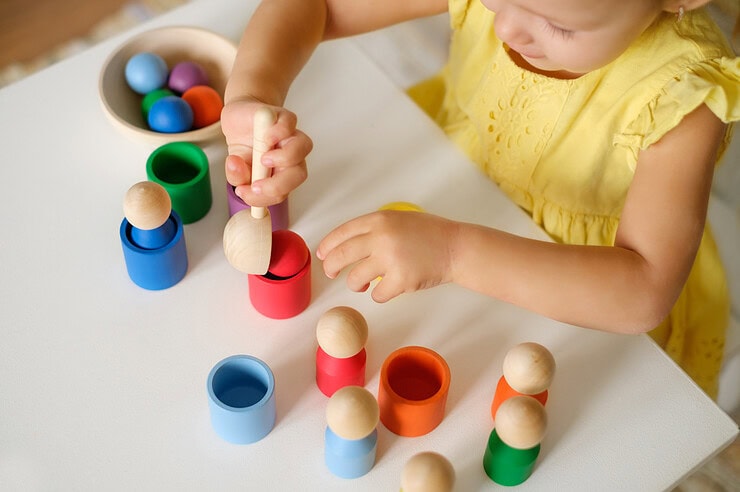
Tasks that involve sorting and grouping are important in the early years – and so is the language that we use around them. “You want both of these things together,” Samuelson says.
When naming a characteristic of an object, you can also label the group it belongs to. For example, rather than saying, “That ball is red,” you might say, “The color of that ball is red.” Samuelson found in her modeling that this helps words bundle as categories in the brain. It may also prime children to direct their attention to the characteristic that’s important.
But this doesn’t mean that adults should constantly hover over children’s shoulders as they explore or play, labeling objects or dimensions, Samuelson emphasizes. “We need to let them explore and play and learn through doing, and messing up, and putting things together in weird ways, and then figuring out why it doesn’t work,” she says.
When it comes to developing executive function, learning language and labels is important. But so is giving children room to explore and make mistakes.
Author